A claim can be factually strong and still start in the wrong courthouse. Before filing a small business dispute, check three separate questions: does this court have authority over this type and amount of case, is this geographic location allowed by its venue rule, and is the named business or person the right party to sue? Venue is only the second question. A connection such as “the owner lives here” or “the work was online” does not automatically answer it.
This guide gives you a repeatable way to research the rule and organize the facts. Small-claims procedures are state and sometimes county specific; use the current court’s own rules and forms for the final decision. This is general educational information, not legal advice; the right filing location depends on the law and facts in your jurisdiction.
Check the court, the location, and the plaintiff separately
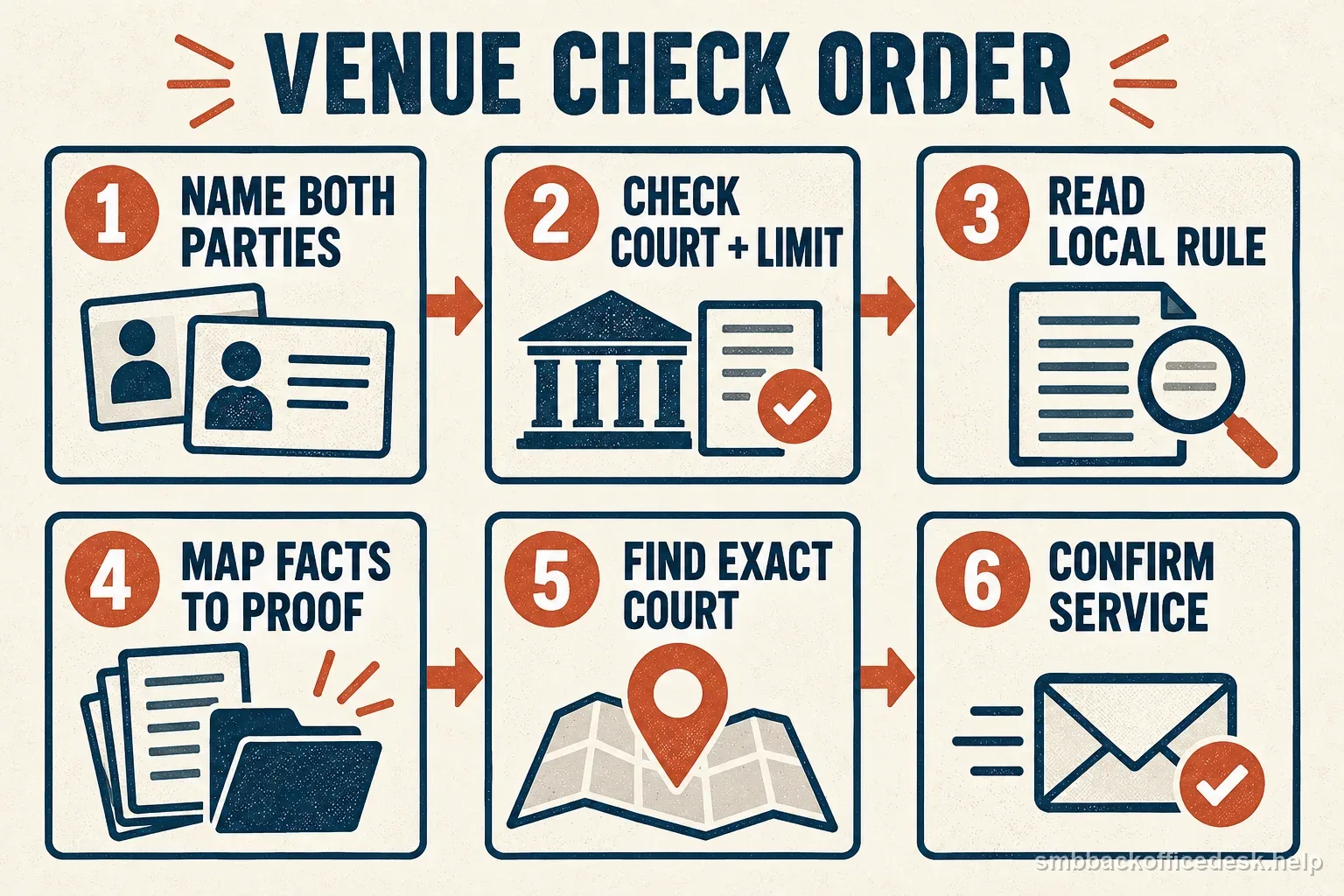
Start by writing down the exact legal claimant and defendant, the relief requested, and the amount. A sole proprietor, LLC, corporation, partnership, and individual may have different filing options even when the same person runs the business. Check that the person or entity named on the agreement or invoice is also the party that owns the claim. For evidence that ties a business invoice to the contract, work, credits, and balance, see the small-claims invoice evidence guide.
Then separate the issues:
- Jurisdiction: Does the court have authority over this defendant (personal jurisdiction) and this type and amount of claim (subject-matter jurisdiction)?
- Venue: Which county, precinct, or courthouse is geographically proper under this court’s rule?
- Party and service: Who must be named, and what address or authorized recipient will let the case be served?
A favorable answer to one does not establish the others. A courthouse can be close and still lack a valid venue connection; a correct location can still be the wrong court division or the wrong claimant.
| Venue | Jurisdiction | |
|---|---|---|
| Question | Which geographic court? | Does type/amount belong there? |
| Evidence | Defendant and transaction locations | Plaintiff, remedy, amount, limit |
| Contract | Forum clause may matter | Governing law alone may not pick court |
Read the local venue rule before choosing a location
Use the official state judiciary page, the rule or statute it identifies, and the local court’s filing page. Check both the county and, where applicable, the precinct or courthouse. The [USAGov court locator](https://www.usa.gov/courts) can help you find an official court site, but the local court’s current instructions control the filing details.
Rules vary. California Courts generally direct filers to the county where the other side lives or does business and describe claim-specific alternatives; the Los Angeles court lists contract locations such as where it was signed or where the defendant was to perform. Texas Justice Court Rule 502.4 identifies defendant residence, where the incident or most incidents occurred, where the contract was to be performed, and—in a property-recovery suit—where the property is located. Texas Rule 502.4(c) also has a specific fallback when a defendant lives outside Texas or the residence is unknown: the Texas State Law Library says filing may be in the plaintiff’s county and precinct. Confirm the current rule and facts before relying on that exception. These are examples of different state rules, not a national menu from which a plaintiff may freely pick.
Record the exact rule and the fact that connects your claim to each possible court. If you cannot state both in one sentence—“Rule ___ permits this court because ___ happened here”—pause and verify with the court’s official self-help resource or a qualified local attorney.
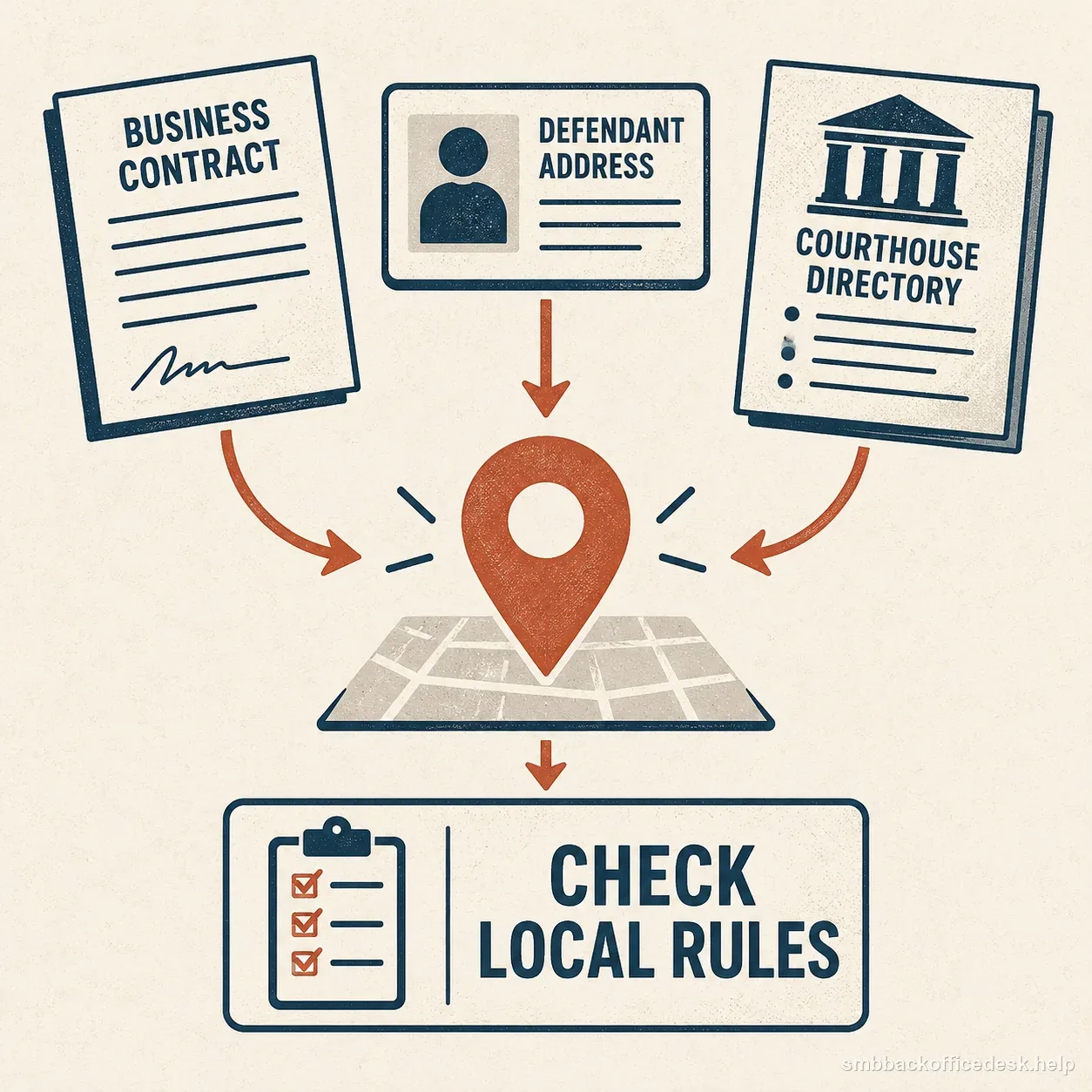
Check the agreement, defendant location, and court guidance for the governing jurisdiction.
Map the defendant and the transaction to evidence
Make a location inventory before comparing courts. Include the defendant’s residence or business address, the place the agreement was made, the place the defendant was expected to perform, where the key events happened, and the location of disputed property if the claim seeks its return. Add the plaintiff’s location only if the rule recognizes it for this claim.
For each fact, keep its source: the signed agreement, order or project record, delivery receipt, dated work log, defendant’s current business filing, or a court record. A business registry can help confirm a legal name or registered agent; it does not, by itself, prove that every county where the business is registered is proper venue. Check the court rule separately.
Remote work needs the same discipline. “We communicated online” is not a geographic rule. Identify what the agreement required, where the defendant was to perform, where the work or goods were delivered, where the alleged breach occurred, and what the controlling local rule treats as relevant. Do not turn the plaintiff’s home office, cloud server, or payment processor location into a venue connection without authority for that conclusion.
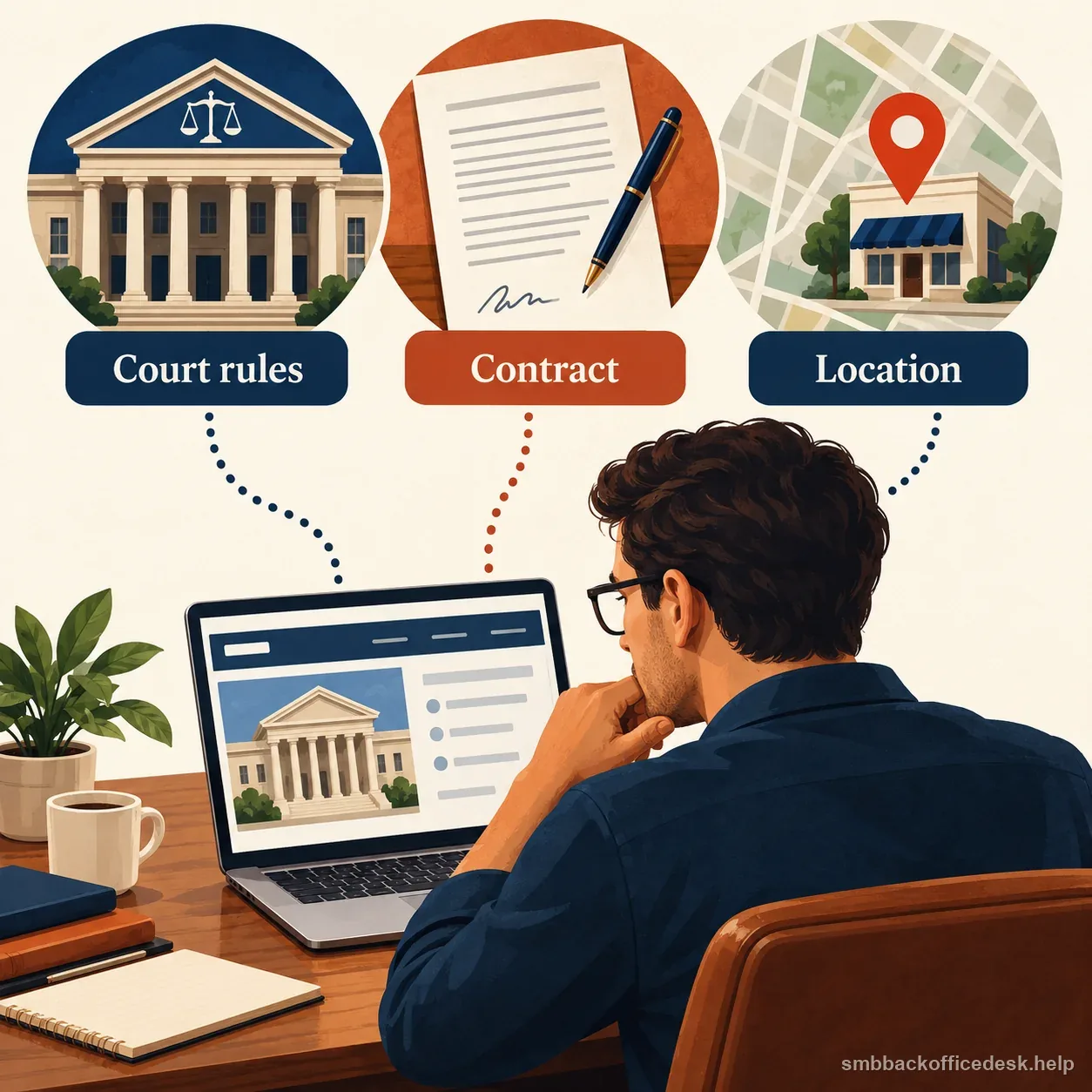
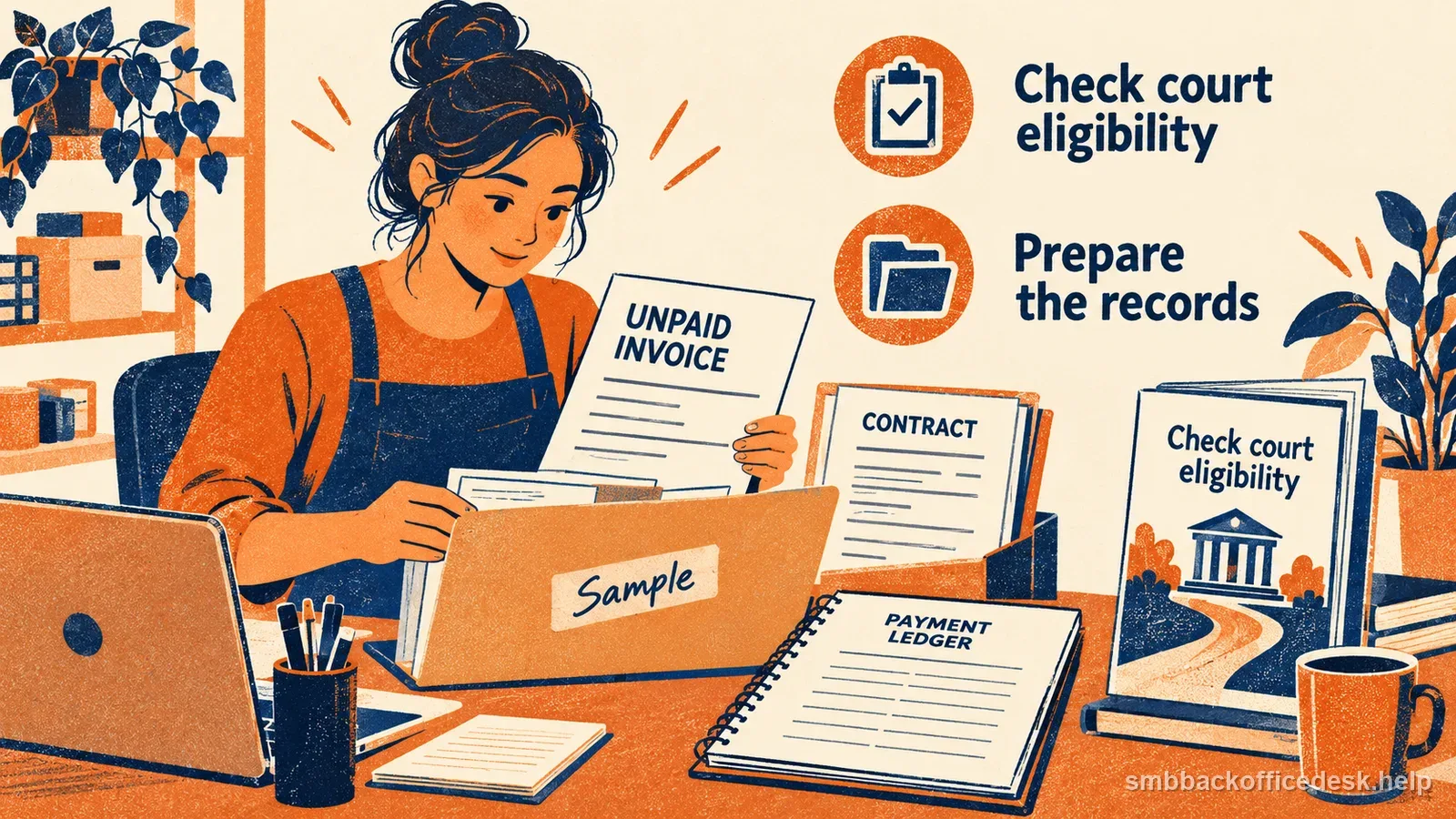
A small-business owner checks court rules, the contract, and the business location before choosing where to file.
Treat contract clauses as a question to verify
Read the whole dispute section, including any forum-selection, venue, arbitration, governing-law, notice, or small-claims waiver language. These provisions answer different questions. A clause selecting the law of a state does not necessarily select a courthouse there; an arbitration clause may point away from court; and a county named in a venue clause may be subject to state-specific enforceability limits.
Indiana’s Small Claims Rule 12, for example, says a contract cannot waive that rule’s venue provisions. That is an Indiana rule, not a general rule for every state. If a clause conflicts with the court location you are considering, find the current rule governing that clause and this kind of claim before filing. Do not assume the contract wins or loses without checking.
Save the complete signed version and the page containing the clause. If the agreement was accepted online, preserve the version shown to the customer and the acceptance record rather than relying on a later template.
Confirm the claimant type and amount limit
Verify that this claimant may use the specific small-claims procedure. New York City is a useful example of why this check matters: its Small Claims Court permits an individual to sue, while corporations, partnerships, associations, and assignees cannot start an ordinary Small Claims case there; eligible business entities have separate Commercial Claims or Consumer Transaction procedures. The commercial procedure has its own claimant and venue requirements. Do not treat a trade name or the owner’s personal name as interchangeable with the business entity named in the contract.
Limits also differ. California Courts currently state a $12,500 limit for individuals and a $6,250 limit for businesses in ordinary small claims. The applicable limit and rules for counting interest, filing fees, or other costs depend on the jurisdiction and case type. Check the official court page for the date you plan to file. If the balance is above the limit, determine whether the rules allow a waiver of the excess or require a different division; do not split one claim to evade a limit.
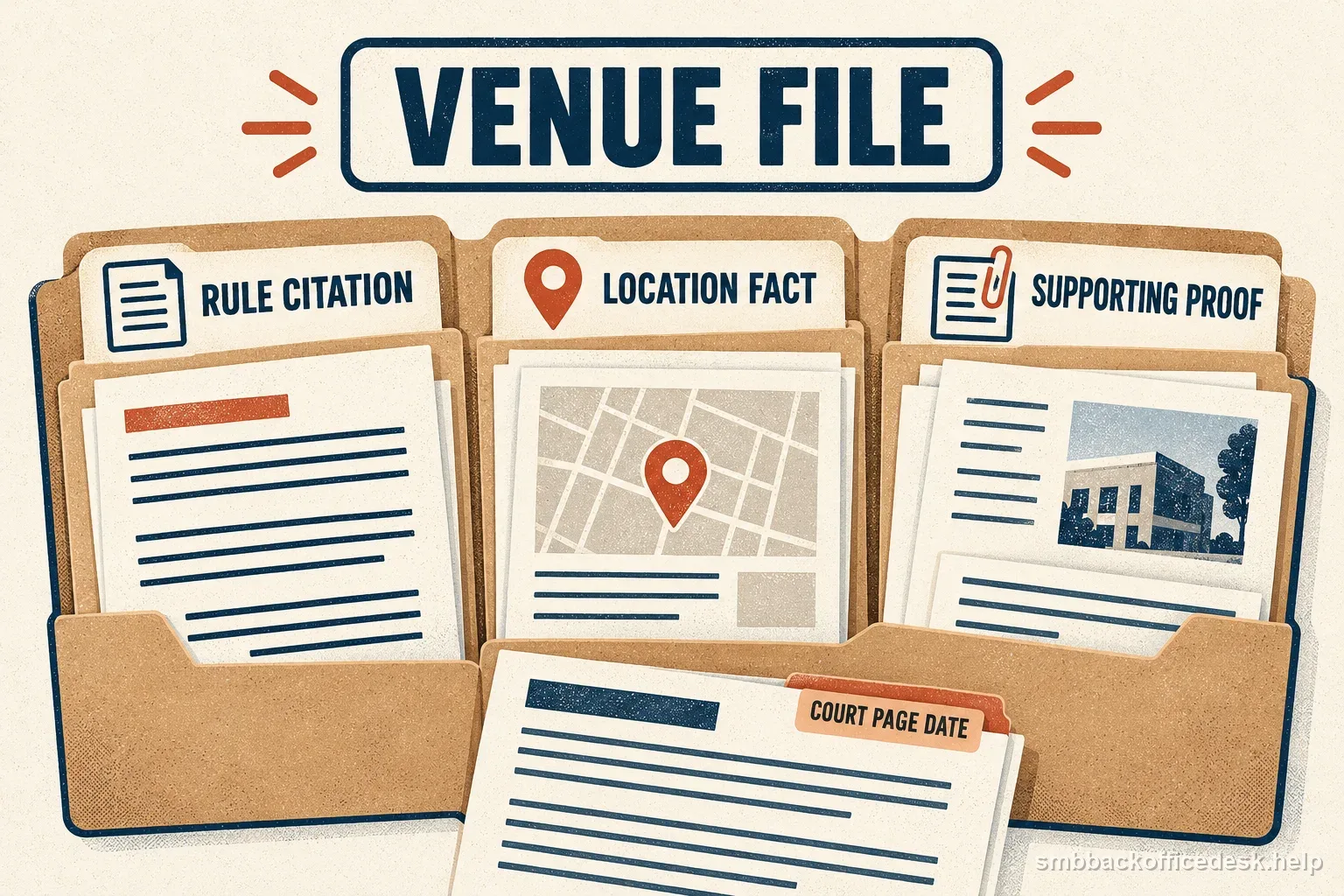
A simple venue file preserves the rule, location fact, supporting proof, and date of the court page you checked.
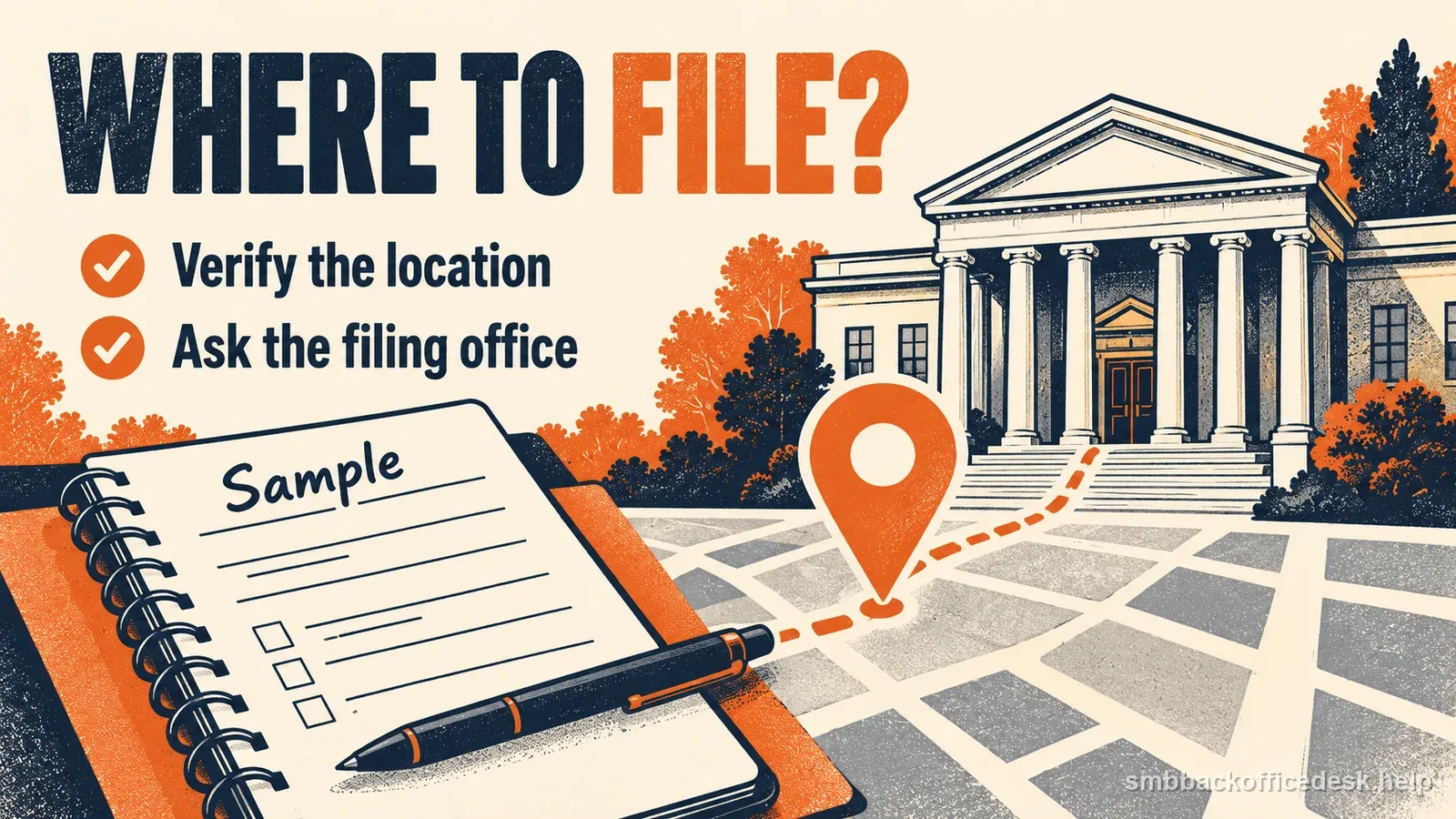
Choose the exact county, precinct, and courthouse
A county can contain several courthouses or justice-court precincts. Once the rule identifies a proper county, use the court’s venue lookup, precinct map, case-type page, or clerk instructions to locate the correct filing office. Confirm the current form, whether filing is online, by mail, or in person, the filing fee, and whether the court requires a venue explanation on the claim form.
California’s SC-100, for instance, asks the plaintiff to state a legal reason for filing in the selected location. The Los Angeles court warns that filing in the wrong county or courthouse can lead to transfer or dismissal without prejudice and another filing fee. Use those details as California-specific examples; follow the form for your own court.
Before submitting, check the filing page again. Court websites, boundaries, forms, and local procedures can change. Save the official page or PDF with the date you checked it.
Compare candidate courts in a short worksheet
When more than one location might qualify, make a row for each candidate rather than choosing from memory. Note the rule citation, the connecting fact and its source, the exact courthouse or precinct, whether the claimant and amount fit, the filing method, and how the defendant can be served. Add practical considerations—witness travel, hearing format, cost, and where collectible assets may be—but only after confirming the location is legally allowed.
A practical screen looks like this:
| Candidate | Rule-based connection | Evidence | Claimant and amount fit? | Filing and service check |
|---|---|---|---|---|
| Defendant’s county | Residence or business location recognized by local rule | Current address or official business record | Check court type and cap | Confirm precinct and service method |
| Contract location | Signing or performance location, if this claim’s rule allows it | Signed agreement, work order, delivery record | Check party eligibility and cap | Confirm exact courthouse and forms |
| Event or property location | Incident or property connection recognized by local rule | Dated event record or property record | Check the proper remedy and amount | Confirm service and hearing logistics |
Leave a candidate out if its only advantage is convenience. If the official wording is unclear, ask the clerk which court handles that filing and where the rule is published; clerks can direct you to procedure but may not advise which court is legally best for your facts.
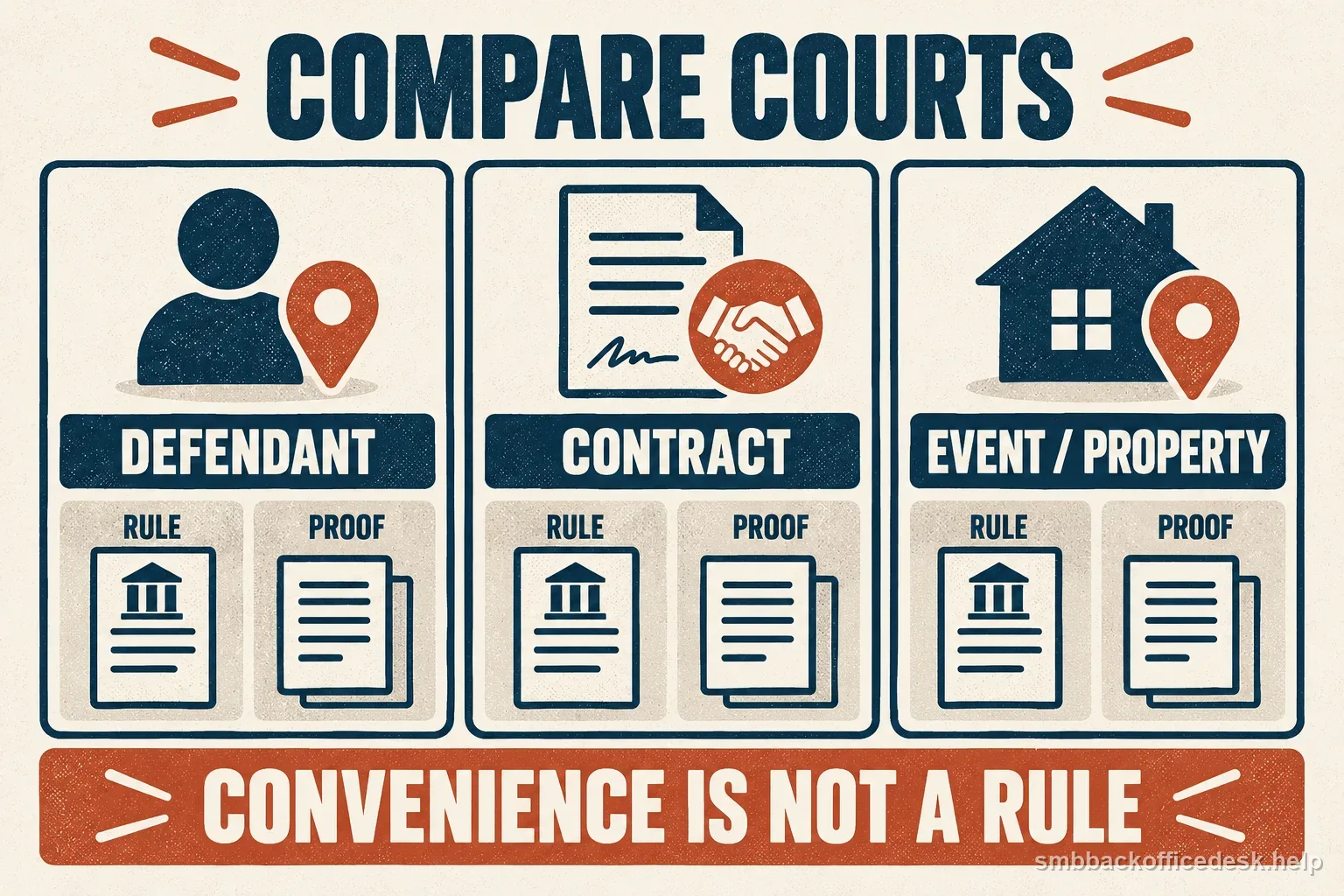
Compare the rule, location fact, proof, claimant eligibility, amount, and service path for each candidate court.
Build a file that explains the venue choice
Keep a one-page venue note with the rule citation, the chosen county and exact courthouse, the connecting facts, and the records supporting each fact. Attach the relevant contract page and current defendant-address record. Keep separate copies of filing and service instructions. This makes it easier to complete the venue section accurately and answer a transfer or venue objection without reconstructing the research later.
Do not confuse the address used for service with the legal reason venue is proper. A registered agent’s office may be the right recipient for service under state law, but the court’s venue rule may ask a different question. Confirm each requirement on its own terms.
Keep the court rule and supporting location evidence together before filing.
If the defendant challenges venue
Read the notice or motion and its deadline promptly. Compare the defendant’s objection with the rule you relied on and the evidence in your venue note. Follow the court’s instructions for a response or hearing; do not assume the clerk will move the case automatically. A court may transfer or dismiss a case depending on local law and the facts, so do not promise yourself that an incorrect filing can be fixed without cost or delay.
Work through a remote-project example
Suppose a Nevada designer signs a services agreement with a California company, completes the design remotely, and sends files online. The designer should not choose a Nevada court merely because that is where the laptop was used, or a California court just because the agreement names California law. The designer should identify the defendant’s business location, the contract’s actual forum and performance terms, where deliverables were required and accepted, and any documented event tied to nonpayment. Then compare those facts with the current venue rule for each candidate court, and separately check small-claims eligibility, amount limits, and service. If no rule clearly supports a location, get jurisdiction-specific guidance before paying a filing fee.
The filing decision is ready when you can identify the correct claimant, the permitted court and exact location, the rule that supports venue, the evidence for that connection, the amount limit, and a workable service path. Keep those checks together with the agreement, invoice, work records, and payment ledger so the court choice is explainable rather than a guess.