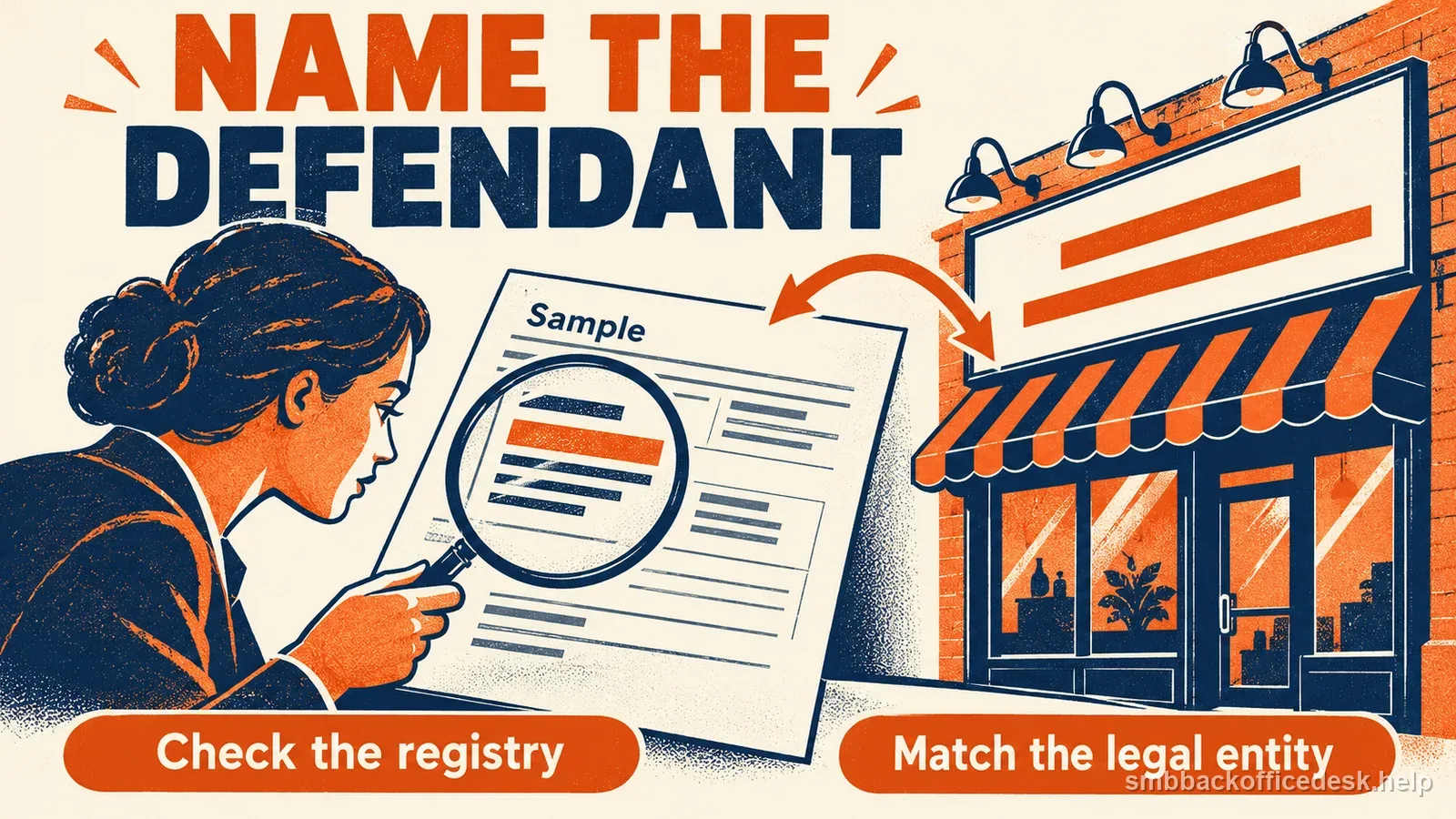
Winning against the wrong name can turn a simple unpaid-invoice case into a collection problem. Small businesses often trade under a brand that is not the legal entity: “Oak Street Design” may be Oak Street Design LLC, Jane Smith doing business as Oak Street Design, or a brand owned by a different corporation.
California’s small-claims instructions specifically warn plaintiffs to list the proper legal name because an incorrect name can interfere with collection.
Start with the documents that created the relationship
Look at the signature block on the contract, W-9 if one was exchanged, purchase order, invoices, checks or ACH payer name, customer email signature, and tax documents.
Pay attention to capacity. “John Lee, President, Acme Holdings Inc.” usually signals the corporation as the contracting party, not John personally. “Jane Lee d/b/a Acme Repairs” points toward a sole proprietor using a trade name.
Do not assume the person who negotiated the deal personally owes the company’s debt. Compare the legal name across the signed agreement, tax form, invoice addressee, payment remittance, and registry. A W-9 or payer name can help reconcile the records, but neither alone settles who contracted. Save a dated registry result because status and agent details can change. If the documents identify different entities, resolve the mismatch before drafting a claim.
- Relationship recordsRead contract, payer, and signer capacity.
- RegistryConfirm entity name, status, and agent.
- Trade nameConnect public name to legal owner.
- CaptionFollow local naming rules.
- ServiceCheck authorized recipient.
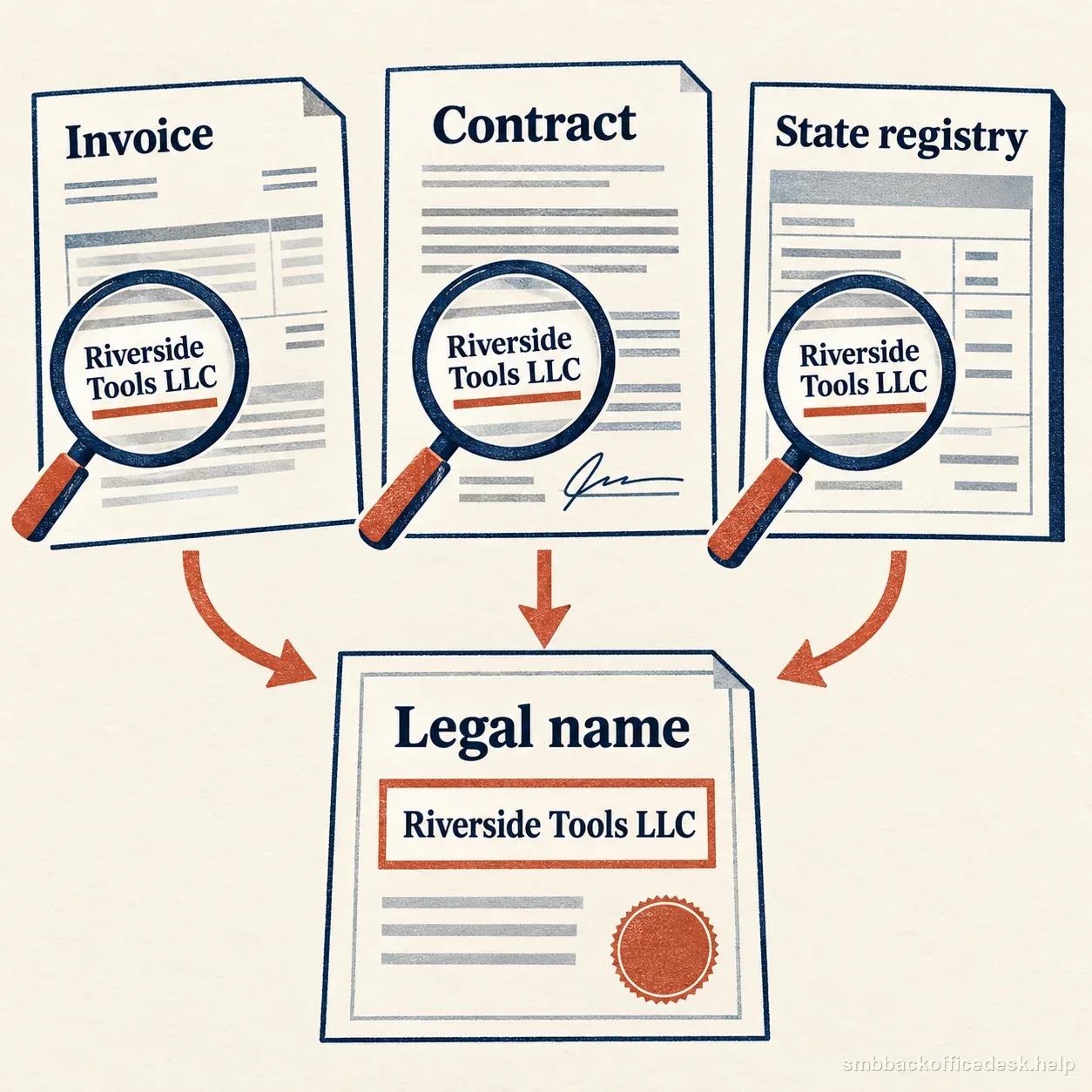
Illustrative cross-check: compare the contract, invoice, and entity registry for the same party. Actual records can differ and must be reconciled.
Search the state business registry
Use the Secretary of State or equivalent official business-entity search for the state of formation or registration.
Record: - exact legal name; - entity type; - status; - principal/mailing address if published; - registered agent or agent for service; - entity number; - date checked.
Check spelling and punctuation exactly enough to distinguish similar businesses. “ABC Services LLC” and “ABC Service Group LLC” may be unrelated.
If the entity is inactive or dissolved, do not guess the consequences. State law determines whether and how it can be sued and served. Also choose the official record that matches the business form. A Secretary of State search commonly covers registered corporations and LLCs, while a county clerk or another local office may hold an assumed-name filing. One database may not show every name the business uses. Save the exact source, search date, legal name, entity type, status, and entity number; if the public record conflicts with the contract, investigate before writing the defendant line.
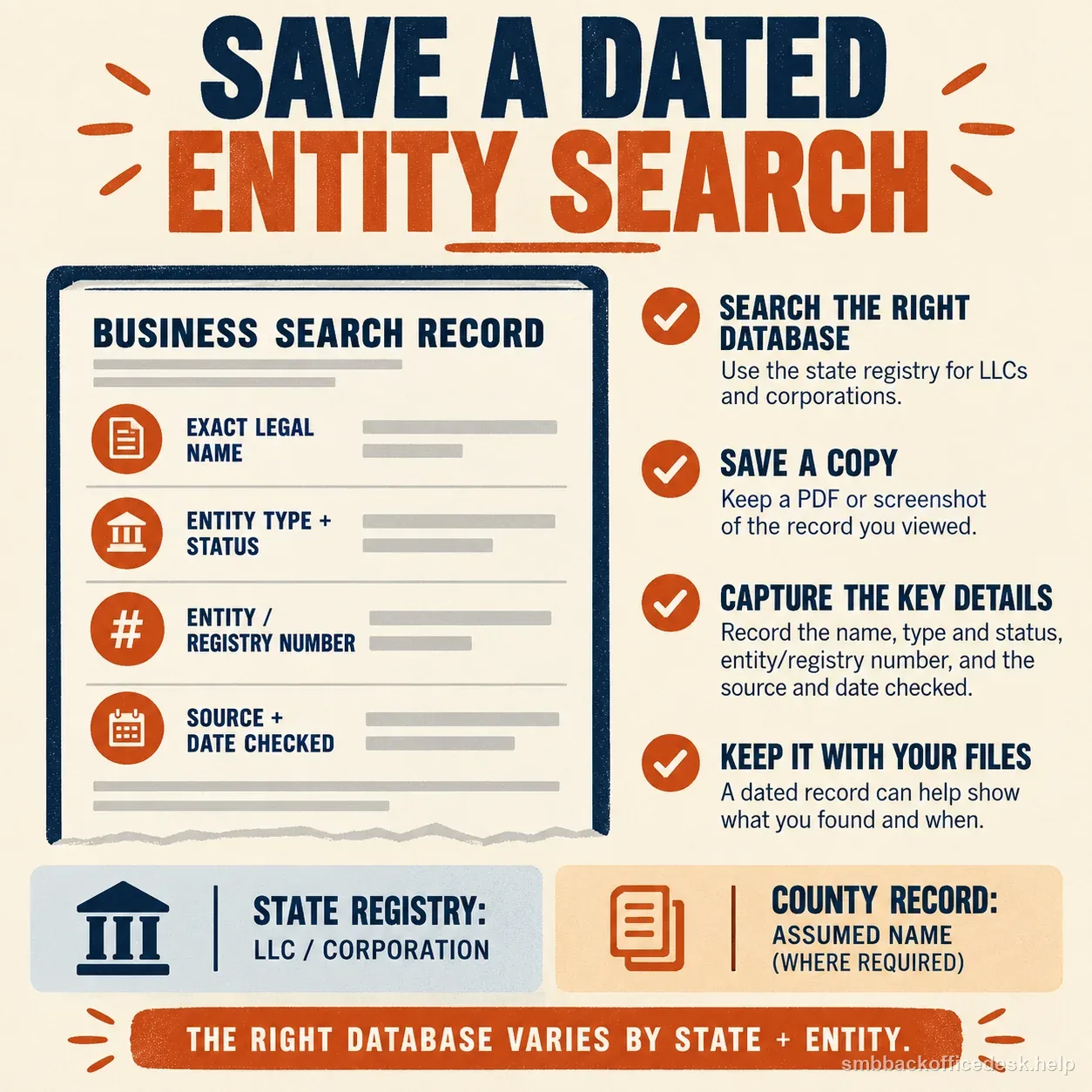
Capture the source and date with the name, status, entity type, and number. The right database differs by state and business form.
Investigate fictitious or assumed names
Trade names may be registered at a county, state, or local level depending on jurisdiction. Search the appropriate official source. A DBA is a name used by its owner, not automatically a separate company. Follow the records from the public name to the person or entity behind it, and check whether your court accepts or requires a particular caption.
Connect the trade name to the legal owner. Your caption may need a form such as “Jane Smith, individually and d/b/a Oak Street Design,” or the court may have its own preferred format. Use the local self-help instructions rather than inventing a caption.
In California, current small-claims forms include SC-103 for a business claimant using a fictitious business name, and court materials also provide specific guidance for identifying and serving businesses.
Match the defendant to the contract and the remedy
Ask: Which person or entity made the promise I am enforcing? Which one received the service? Which one was invoiced? Which one paid previous installments?
If the answers point to different entities, investigate why. A parent company, subsidiary, franchise, and individual owner are not interchangeable merely because they share branding.
Piercing an LLC/corporate veil or imposing personal liability on an owner is a substantive legal issue, not a clerical fix. Do not add every owner as a defendant “just in case.” Separate grounds vary by state; issues to verify can include a personal guarantee, a contract made before the entity existed, or an actionable act by the owner personally. Those are distinct questions, not reasons to assume liability from ownership alone. If the facts do not clearly identify who promised payment, check local law before filing.
A worked example
Suppose a small supplier is owed an illustrative $522.50 for $450 of tools, $25 shipping, and $47.50 tax. The signed order says Riverside Tools LLC; the manager signs “for Riverside Tools LLC”; the invoice is addressed to the same LLC; and the state record shows that exact entity name. Those consistent records point to the LLC as the contracting party to investigate for the claim. They do not make the manager personally liable just because the manager signed. The public record’s service contact is a separate detail: use the court’s current rules to determine who may receive the papers for the named entity. If a W-9 or payment record instead identifies another company, stop and resolve that mismatch rather than selecting the easiest name.
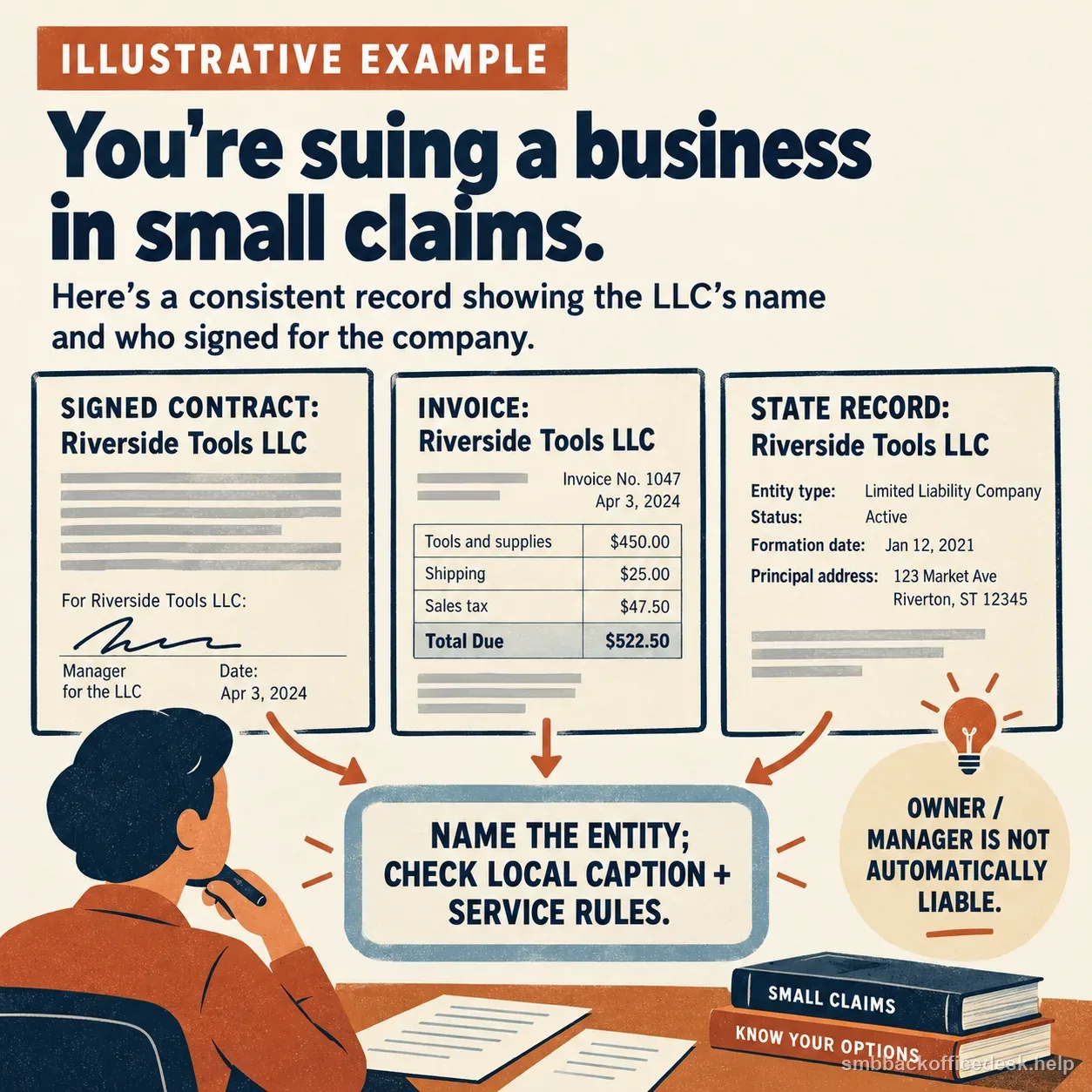
Illustrative, invented $522.50 transaction: a contract, invoice, and registry use the same LLC name; a manager’s signature alone does not make that manager personally liable.
Service requires a second identification step
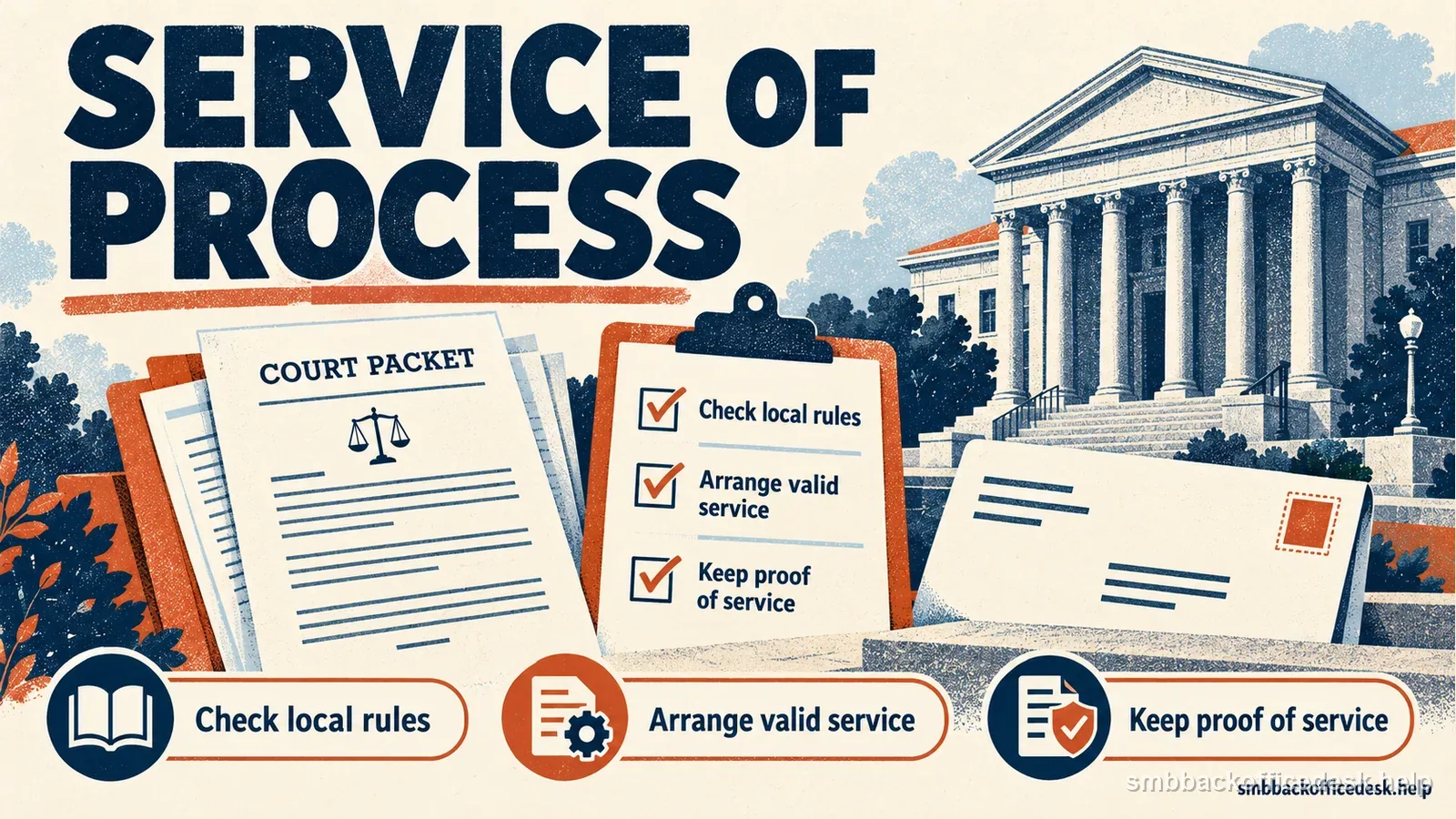
Once you know the defendant, determine who can legally receive process for that defendant. An LLC or corporation may be served through its registered agent or another authorized person under state rules.
The right mailing address for invoices is not automatically the right service address. A customer’s accounting department is not automatically an authorized agent. A registered agent may accept papers for an entity without being the person or company that owes the debt; name the defendant and identify the service recipient separately.
Give your process server the exact legal name and the court’s business-service instructions. Preserve the filed proof of service. Keep the caption and service instructions in separate fields on your worksheet: the defendant is the person or entity you allege is legally responsible; the service recipient is the person authorized under the applicable rule to accept papers. In many states a registered agent serves the second role for a company, but the correct method and recipient depend on the state, entity status, and court.
| Where to look | What it shows | What to watch for |
|---|---|---|
| Contract signature block, W-9, purchase order, invoices, payer name on checks or ACH | Who actually contracted, and in what capacity | "John Lee, President, Acme Holdings Inc." usually points to the corporation; "Jane Lee d/b/a Acme Repairs" points to a sole proprietor using a trade name |
| State business registry | Exact legal name, entity type, status, address, registered agent, entity number | Spelling and punctuation matter ("ABC Services LLC" and "ABC Service Group LLC" may be unrelated); save a dated result |
| Fictitious or assumed name records | Which legal owner stands behind a trade name | The caption may need a form such as "Jane Smith, individually and d/b/a Oak Street Design"; use the court's own instructions |
| Service information | Who can legally receive the papers for that defendant | An invoice address is not automatically a service address, and an accounting department is not automatically an authorized agent |
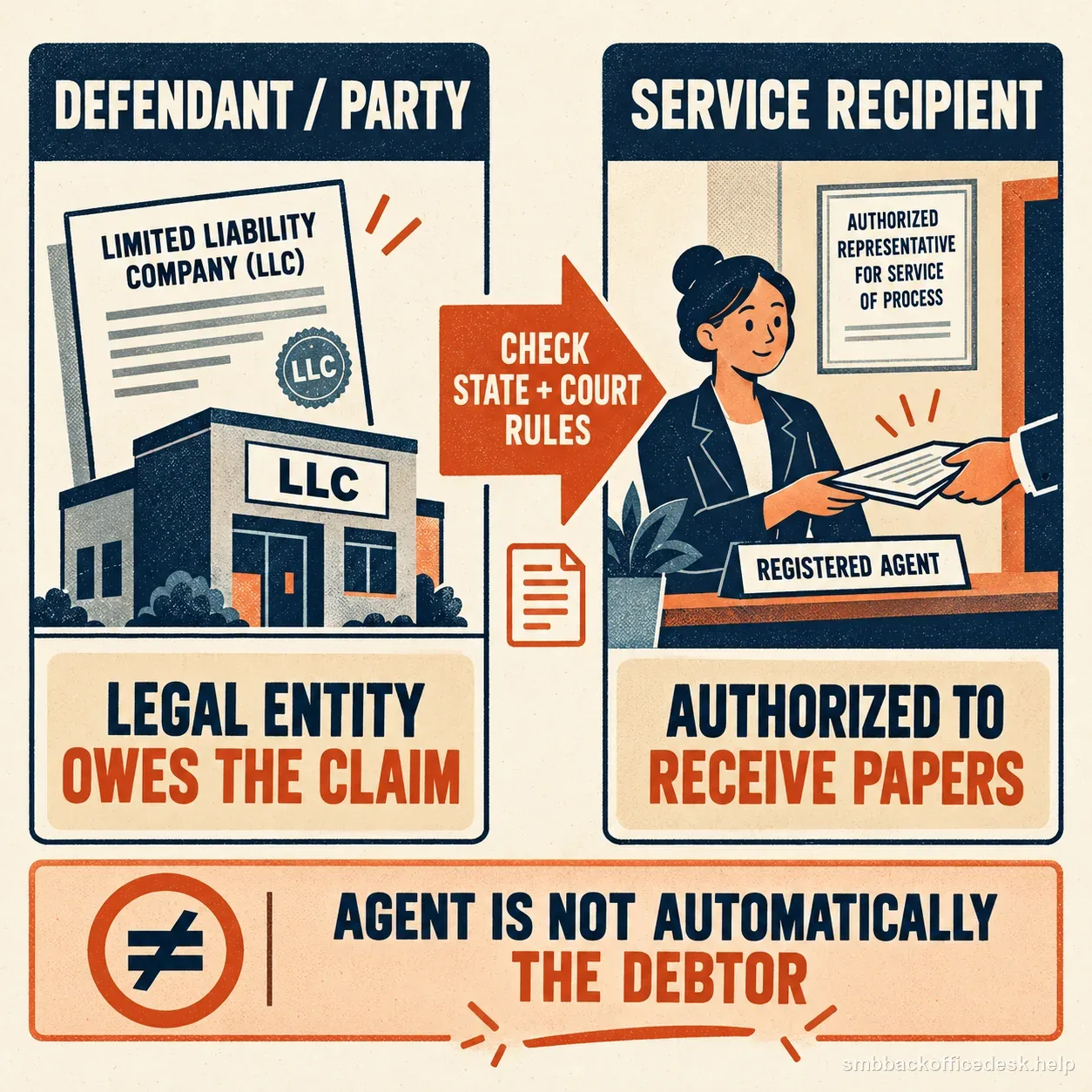
The named party and the authorized person who receives papers serve different roles; check the current state and court rules.
Correct a mistake before the hearing if possible
If you discover a naming error after filing, contact the clerk or use the court’s published procedure for amending the claim. Do not simply cross out the old name on your copy.
A correction can affect service. If the defendant changes, the newly named party may need proper service and sufficient notice before the hearing. A court may treat a spelling correction differently from replacing one legal person with another. Do not assume that a clerk can approve the change, that an amendment relates back to the original filing date, or that existing service remains valid. Follow the court’s published procedure and verify any deadlines, service, and hearing-notice steps that apply.
| What you find | What it points to | What to do |
|---|---|---|
| "John Lee, President, Acme Holdings Inc." on the contract | The corporation as the contracting party, not John personally | Name the entity as the defendant |
| "Jane Lee d/b/a Acme Repairs" | A sole proprietor using a trade name | Use the court's caption form, such as "individually and d/b/a" |
| Documents that name different entities | A mismatch in who contracted | Resolve it before drafting the claim |
| The entity is inactive or dissolved | State law decides whether and how it can be sued and served | Do not guess the consequences |
| A parent company, subsidiary, franchise, and owner share one brand | They are not interchangeable | Ask who made the promise, who received the service, who was invoiced, and who paid earlier installments |
| You want to add the owner personally | A substantive legal issue, such as a personal guarantee, a contract made before the entity existed, or an act by the owner personally | Do not add every owner "just in case"; check local law |
| A naming error discovered after filing | A correction that can affect service | Contact the clerk or use the court's published amendment procedure; a newly named party may need proper service and notice before the hearing |
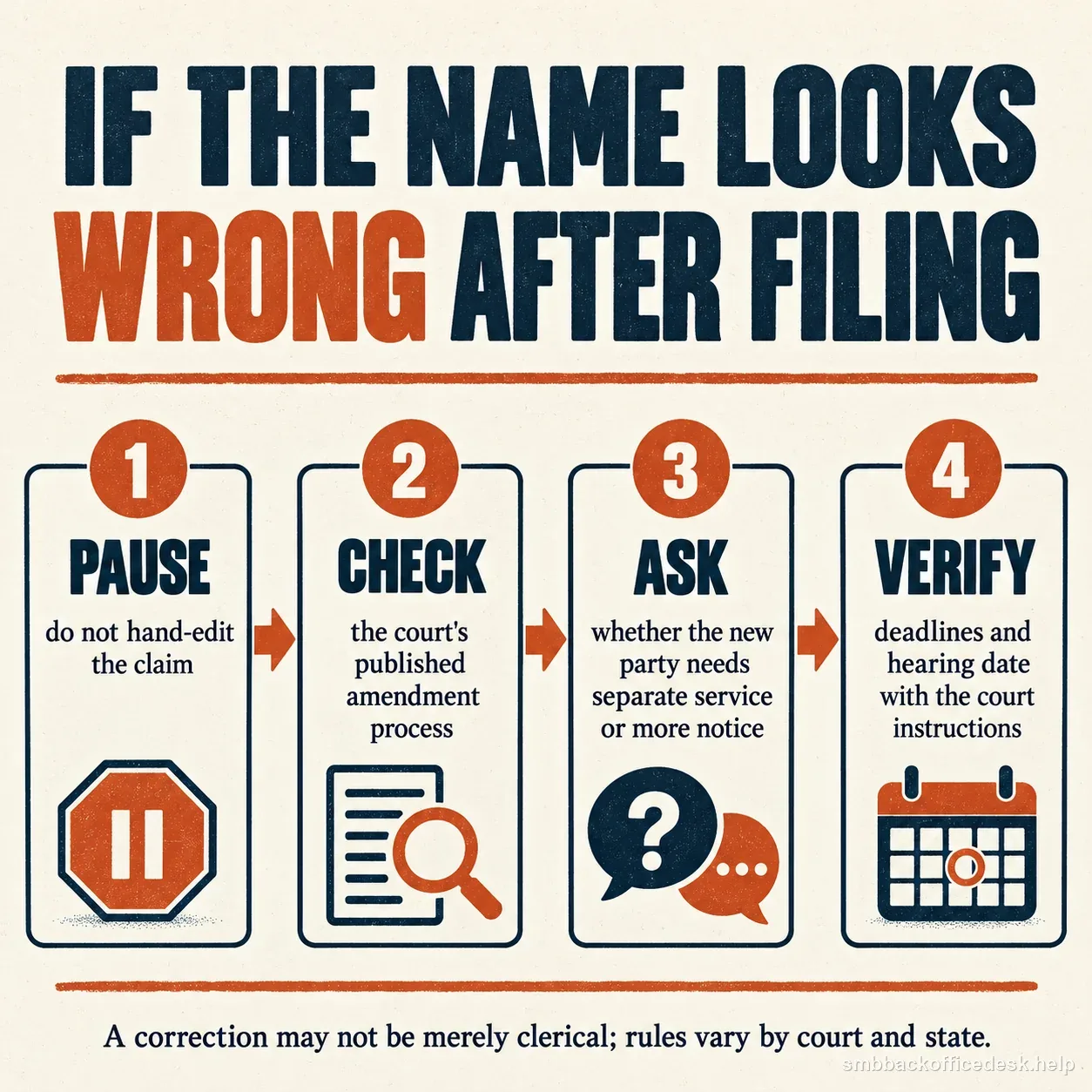
An amendment may affect service, notice, and deadlines; the court’s procedure and result vary by court and state.
Carry the identity proof into the hearing
Bring the registry printout, fictitious-name record where relevant, contract signature page, and payment evidence that connects the legal entity to the transaction.
The identity issue should take one minute to explain: “The contract was signed by X on behalf of ABC Services LLC. The state registry shows ABC Services LLC as the active entity, and its agent was served.”
That clean chain is far better than asking the judge to infer that a logo, website, person, and corporation are all the same defendant.