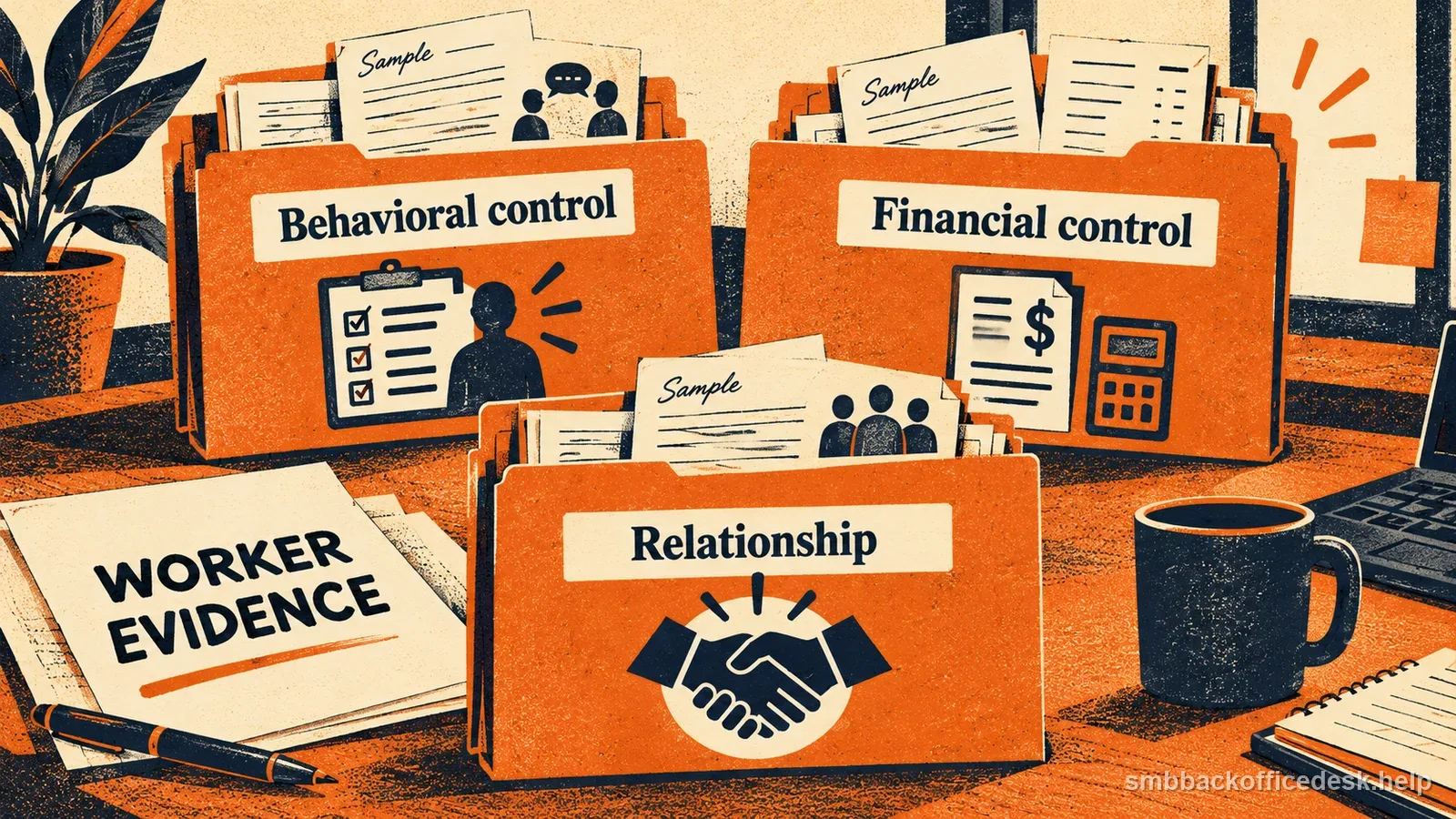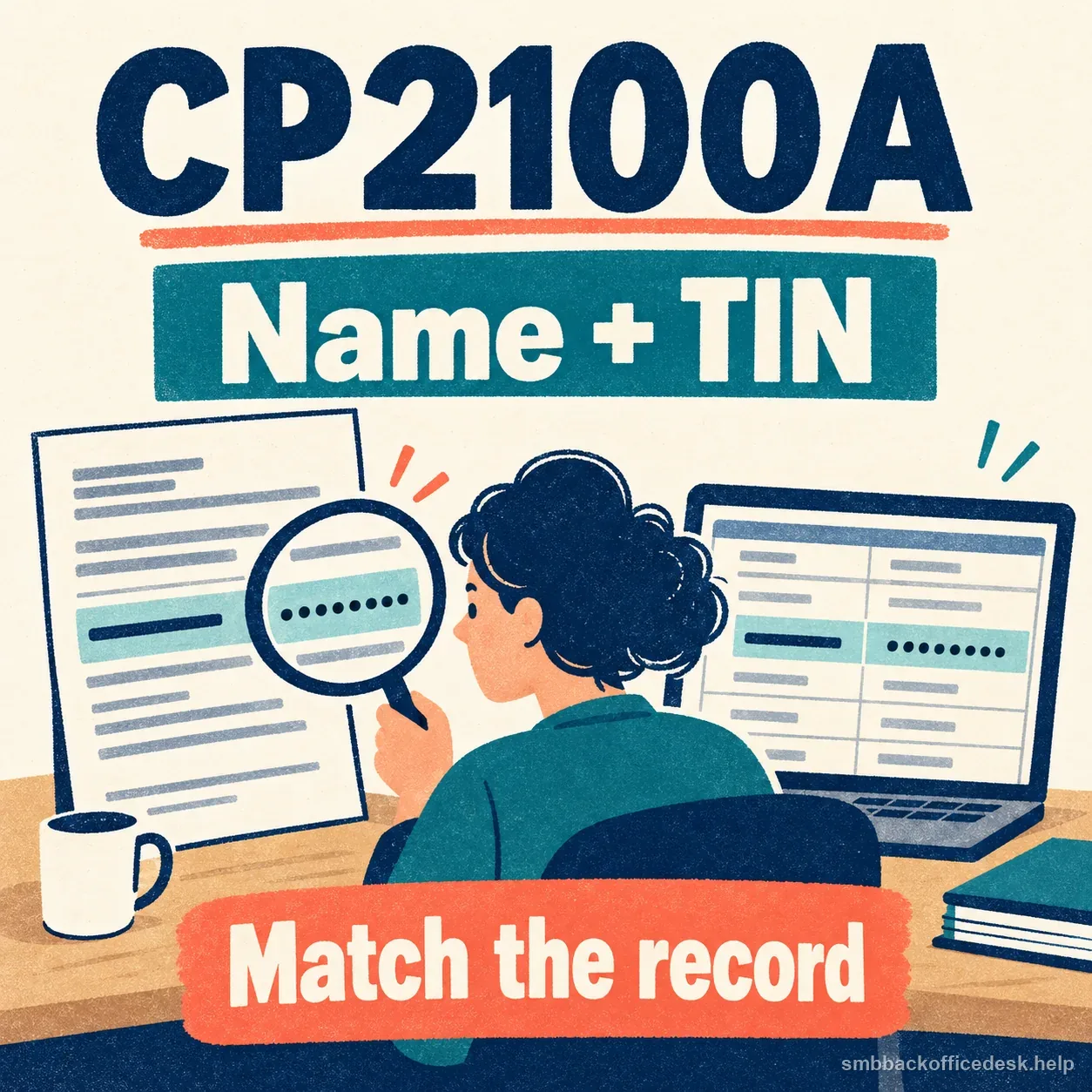
If your business receives an IRS CP2100 or CP2100A, treat it as a payee-record and payment-control task. First compare each listed account with the W-9 and information return you actually submitted. A missing or obviously invalid taxpayer identification number (TIN) has different backup-withholding steps from a name/TIN combination that does not match IRS records. For a mismatch that matches your own file, send the appropriate B Notice; the first and second notices ask for different proof. Record the notice date, recipient contact, future payments, and any withholding. Do not send tax identifiers through ordinary email or put a payee's private information in a shared team note.
What a CP2100 or CP2100A actually tells you
The IRS sends the notice after finding a missing or obviously incorrect TIN, or a name-and-TIN combination on an information return that does not match its records. The IRS describes CP2100 as covering 50 or more error returns and CP2100A as covering fewer than 50; the instructions are otherwise the same. A notice is a signal to compare records and apply the relevant solicitation and withholding rules. It does not, by itself, prove that a vendor committed fraud or that your entire information return is unusable.
Keep the notice with the year and filing batch it identifies. Match the payee name, TIN type, last digits where available, account number, payment history, and the copy of the submitted return. Use a restricted-access folder: the notice may contain sensitive identifying information. Limit access to the staff handling tax reporting and payments, and do not paste full TINs into a general accounting ticket.
| What the notice shows | First comparison | Likely next step |
|---|---|---|
| TIN is missing or obviously invalid | Check the original W-9 request, payment records, and filed return | Begin applicable backup withholding immediately if it has not already started; request the TIN and document the solicitation |
| Name/TIN mismatch and your submitted record matches the notice | Confirm the payee's history of prior mismatch notices | Send the first or second B Notice that applies, then calendar follow-up |
| Notice data differs from your submitted records | Compare the filed copy and transmission confirmation; check for data-entry or processing changes | Correct or update your own records when needed; the IRS says not to call or write merely to report that you updated them |
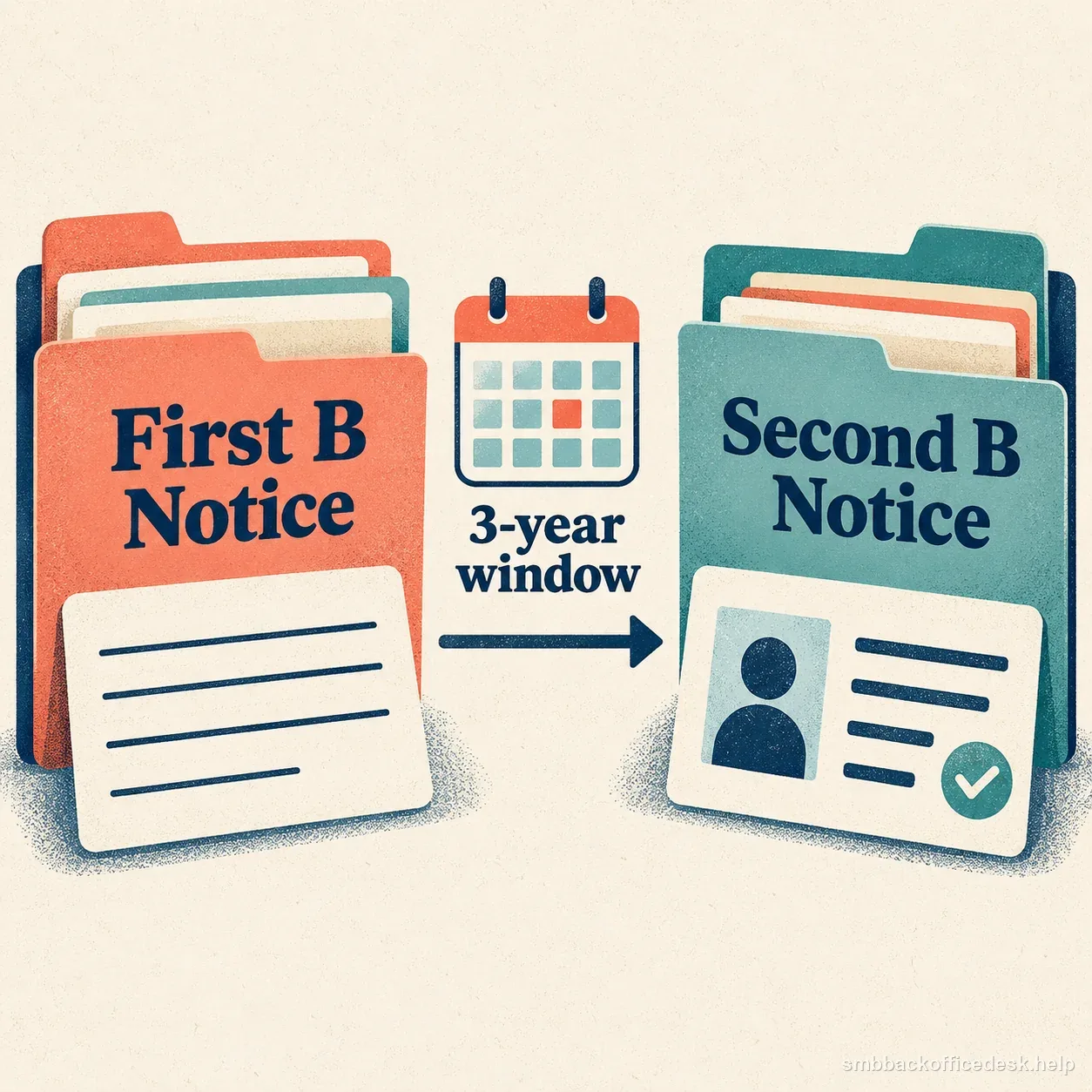
The IRS uses different identity evidence for the first and second notice in the three-year lookback.
Start by sorting the error, not by sending every vendor a form
Make a separate work row for each payee on the notice. Compare it to the exact information return filed, not just the current vendor profile. A later W-9 update can make a current record look correct while leaving the filed record different. If the notice and your copy do not agree, check the e-file acceptance report, any corrected return, and the recipient account number before taking a B Notice action.
For a missing or obviously incorrect TIN, the IRS says backup withholding generally applies to payments when the payee did not provide a TIN or provided an obviously incorrect one. If it should have been occurring but was not, the IRS instructs payers to begin immediately and request the TIN, including for a one-time payment. Continue withholding from applicable future payments until the TIN is received. The IRS also describes up to three solicitations (initial, first annual, and second annual) to avoid a penalty for not including a TIN on an information return. Keep this process separate from the name/TIN mismatch B Notice path.
Choose the first or second B Notice correctly
For a mismatch that agrees with your filed record, check whether the same payee has appeared on a CP2100 or CP2100A a second time within the relevant three-year period. The first appearance calls for a First B Notice and a Form W-9 (or acceptable substitute). The second calls for a Second B Notice; IRS guidance says the payee generally provides a Social Security card copy or, for an EIN, IRS Letter 147C to establish the correct name/TIN combination. Do not substitute a W-9 for the second-notice verification simply because it is easier to collect.
The IRS Publication 1281 and backup-withholding guidance set a 15-business-day window for sending the appropriate B Notice, measured from the notice date or the date you actually received it if later. Put the calculated deadline on a calendar as soon as you log the IRS notice. Use the IRS's current notice text and instructions for the exact version; do not create a homemade letter that omits required language or attachments. Send it through a method your business can document and protect, such as a controlled mail process or secure recipient portal.
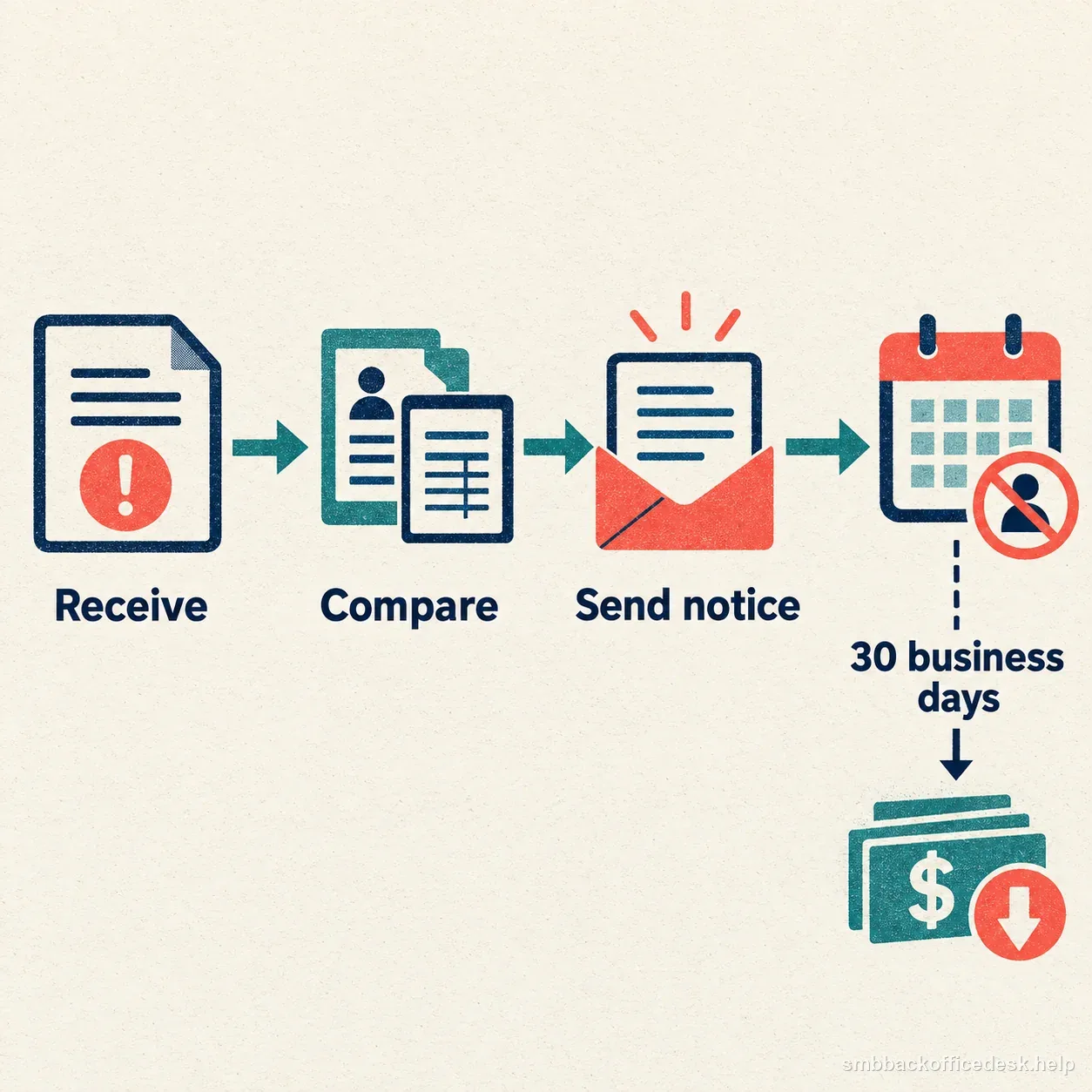
Send the applicable B Notice promptly; the 30-business-day limit shown is the latest withholding start for an unanswered matching record.
Calendar the withholding deadline and the stop date
If a payee whose record matches the IRS notice does not respond, the IRS says you must begin backup withholding on future payments no later than 30 business days after you received the CP2100 or CP2100A. The trigger is not an informal grace period to ignore the notice. Coordinate the deadline with accounts payable before the next payment run so an invoice is not paid in full by mistake.
The current federal backup-withholding rate is 24% of covered payments. For an illustrative $1,000 payment to a payee subject to that rate, $240 is withheld and $760 is paid to the payee before considering any other contract deductions or separate tax rules. Record the gross amount, withholding, net payment, deposit, and payee account separately. The arithmetic is simple; the hard part is applying the right rule to the right payment and keeping the funds out of ordinary vendor disbursements.
When the payee provides the required TIN or verification, the IRS says to stop backup withholding on payments no later than 30 calendar days after receiving the TIN. Give accounts payable a dated instruction to change the vendor hold or withholding flag. Do not rely on an unrecorded conversation, and do not stop withholding solely because someone says a correction is coming.
Deposit and report amounts that you withhold
Backup withholding is not a discount against the vendor invoice. Track the amount as federal tax withheld, deposit it using the applicable Form 945 deposit schedule, and report the withholding on Form 945. The IRS points payers to Publication 15 for deposit timing and to Form 945 for the annual return. Use the same payer name and EIN on Form 945 that your business uses on the information returns; the IRS warns not to use a paying agent's name in place of the payer's.
At the end of each payment period, reconcile the AP ledger to the tax-deposit confirmation and the withholding control account. If a payment was already released without required withholding, preserve the facts and ask a qualified payroll or tax professional how to address that specific payment; do not silently debit a contractor or change the historical payment record. Keep proof of each deposit and any correction with the notice file.
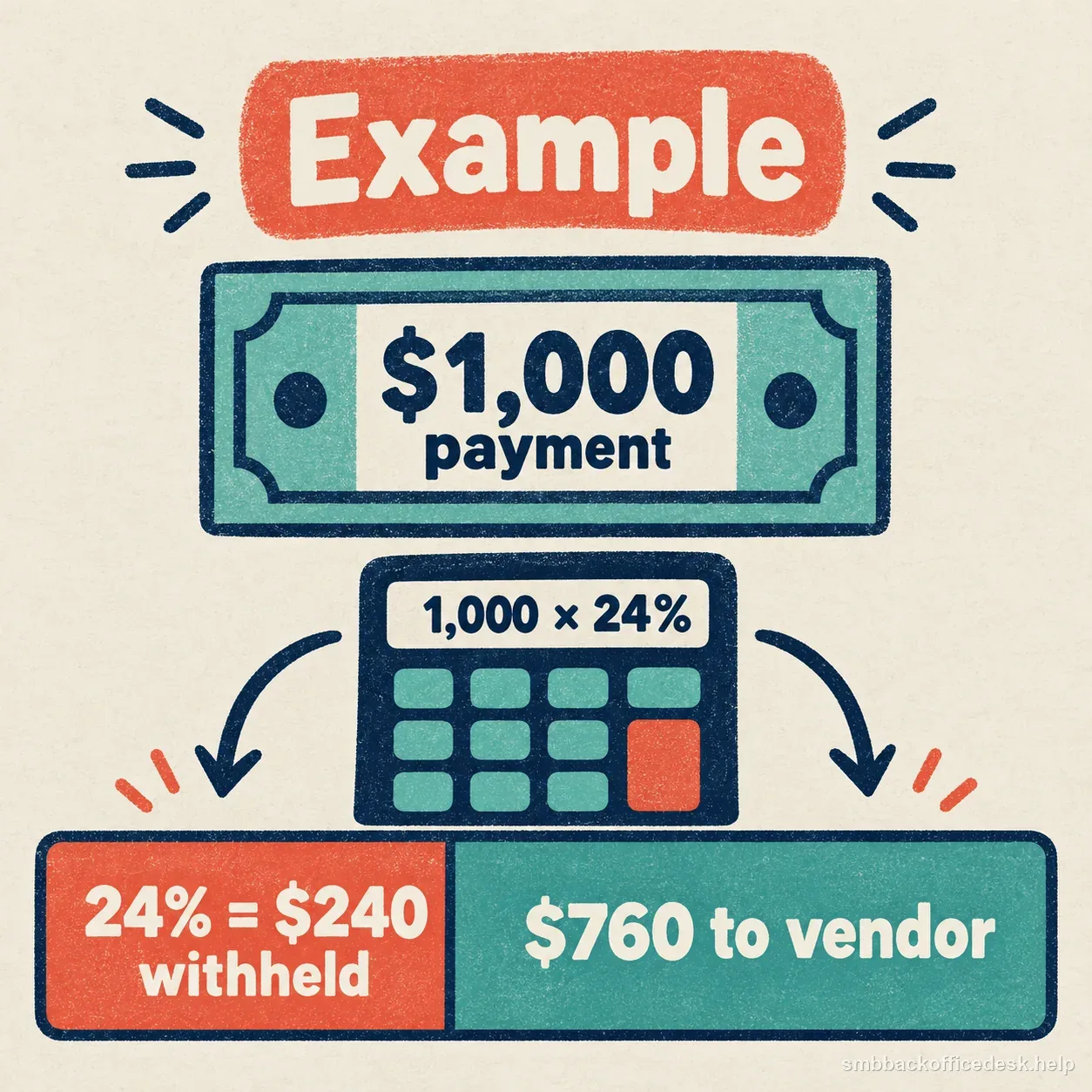
For a covered $1,000 payment, 24% is $240; this example does not determine whether a payment is covered.
A practical notice log for a small team
Use one restricted tracker row per affected payee, with the full TIN stored only in the secured tax record. A workable log includes: notice received date; notice tax year and batch; payee account reference; mismatch category; whether your filed record matches; first/second notice history; date and method of B Notice; response due date; next payment date; withholding start date and amount; date corrected TIN was received; withholding stop deadline; Forms 945 deposit reference; and the person who verified each change.
Before closing a row, confirm that the corrected W-9 or identity evidence is stored in the restricted system, the payee profile was updated without replacing the historical filing copy, AP received the start/stop instruction, and the tax ledger ties to the deposit. This creates an audit trail that explains not only what changed but why the payment treatment changed on that date.
Common mistakes that create a second notice
- Treating every mismatch as a wrong TIN instead of first checking the exact filed return.
- Sending a First B Notice when IRS records show a Second B Notice is required.
- Counting 30 calendar days when the applicable IRS instruction says 30 business days, or starting the count from the wrong receipt date.
- Applying the 24% rate to every vendor payment without checking whether the payment is subject to backup withholding.
- Forgetting the downstream Form 945 deposit and annual reporting steps.
- Storing a full TIN in an unsecured spreadsheet or asking a vendor to email it in plain text.
- Deleting the original filing confirmation after preparing a correction.

A restricted file should retain the notice, identity match, W-9 request, and payment log without exposing full TINs in a shared tracker.
Before closing the case
Match the notice to the filed information return; categorize missing, obviously invalid, and mismatched data separately; send the right B Notice within the applicable window; brief accounts payable on any withholding start date; reconcile withholding deposits and Form 945; and preserve the recipient's corrected information with limited access. If the notice conflicts with your filing evidence, multiple years are involved, payments were already released without required withholding, or a recipient disputes the match, get tax-professional advice before altering past transactions. This guide is operational education, not tax advice.