
The IRS groups common-law evidence into three categories
For federal employment-tax purposes, the IRS asks whether the business has the right to direct and control the worker. Its current small-business guidance organizes relevant facts into three categories: behavioral control, financial control, and the type of relationship. The categories are not three votes, and there is no rule that two out of three automatically produces an answer.
A useful review therefore starts with evidence, not adjectives. “Independent,” “flexible,” and “project based” mean little unless the business can show how the work is actually performed and paid.
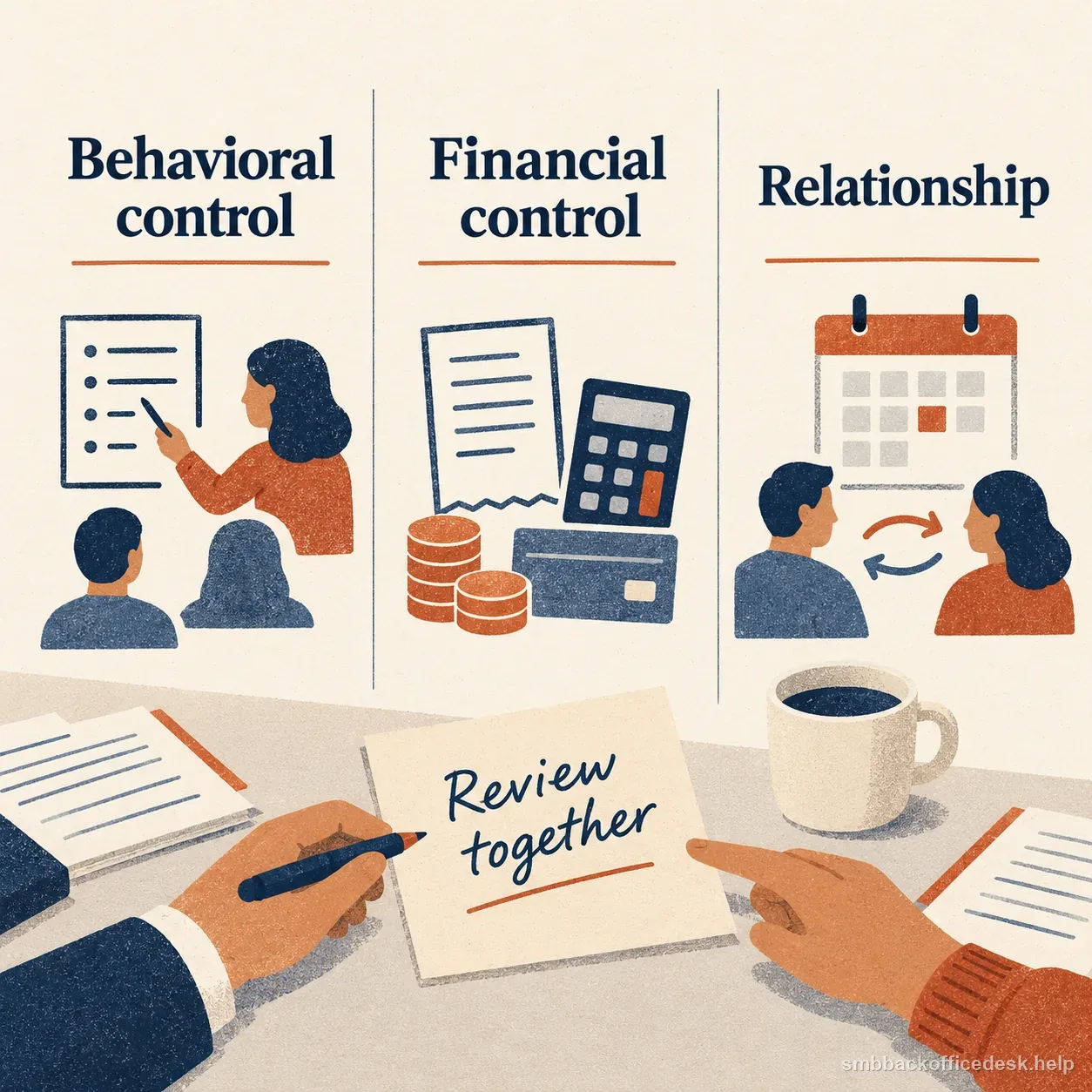
The IRS common-law review groups control and independence evidence into behavioral, financial, and relationship categories.
Behavioral control: who controls the method?
Behavioral control covers instructions, training, and other facts showing whether the business directs how the worker does the job.
Document whether the business tells the worker when and where to work, what tools or equipment to use, which workers to hire or assist with the work, where to buy supplies or services, what sequence or order to follow, or how the result must be produced. The IRS notes that the amount of instruction needed can vary by occupation; a highly skilled person may need little day-to-day instruction while the business still retains the right to control the work.
Training is another signal. Periodic or ongoing instruction about required procedures can indicate that the business expects the work to be performed in a particular way. By contrast, specifying a deliverable, safety requirement, customer constraint, or completion date does not by itself answer whether the business controls the method.
Pull evidence from onboarding messages, operating manuals, calendars, task software, quality-review notes, training records, and manager communications. The question is what rights the company possesses, not merely whether a manager exercised every right every day.
Financial control: is this genuinely a separate business?
Financial control looks at the economic aspects of the activity.
Record the worker’s unreimbursed business expenses, investment in tools or facilities, ability to make services available to other customers, method of payment, and opportunity for profit or loss. A worker who prices projects, controls significant costs, invests in business assets, advertises to the public, and can lose money through poor business decisions looks different from somebody who supplies labor for a fixed wage using the company’s resources.
Do not overread one fact. Employees can have unreimbursed expenses; contractors can be paid hourly; some occupations require little capital. The IRS says all relevant facts must be weighed.
For a real review, compare the invoice terms to the financial reality. Who absorbs rework? Who pays assistants? Who buys software? Does the worker negotiate rates? Can the worker increase profit by managing costs or serving several clients? Those questions reveal more than the word “invoice.”

Expense, tool, and relationship records belong in the same fact review as instructions and contracts.
Type of relationship: what have the parties built?
The third category examines how the parties perceive and structure the relationship. Written contracts can matter, as can employee-type benefits such as insurance, pension plans, paid leave, or vacation pay. Permanency matters too: an indefinite relationship may point differently from a project with a defined end.
The IRS also considers whether the services are a key activity of the business. A company is more likely to have the right to direct and control work that is central to its regular operations, although this fact still belongs in the overall analysis.
Read the contractor agreement alongside offer emails, benefit eligibility, renewal history, termination provisions, job descriptions, organization charts, and the way the worker is presented to customers. If the contract says “independent” but the worker is managed exactly like staff, note the inconsistency rather than hiding it.
| Category | What it examines | Evidence to pull |
|---|---|---|
| Behavioral control | Whether the business directs how the work is done: when and where to work, tools, who to hire, where to buy supplies, sequence, and training | Onboarding messages, operating manuals, calendars, task software, quality-review notes, training records, manager communications |
| Financial control | Whether it is a separate business: unreimbursed expenses, investment in tools or facilities, serving other customers, method of payment, and opportunity for profit or loss | Invoice terms compared with financial reality, such as who absorbs rework, pays assistants, buys software, and negotiates rates |
| Type of relationship | How the parties structured it: written contracts, benefits such as insurance, pension, or paid leave, permanency, and whether the services are a key activity of the business | The contractor agreement, offer emails, benefit eligibility, renewal history, termination provisions, job descriptions, and organization charts |
Build an evidence worksheet, not a scorecard
Use three columns headed Behavioral, Financial, and Relationship. Under each, record facts that point toward employee status, facts that point toward an independent business, and the document supporting each fact. Add a final column explaining why a fact matters.
For example, “Worker chooses which days to perform the project” belongs under behavioral control; “Worker pays for specialized equipment and bears repair costs” belongs under financial control; “Six-month contract for a discrete migration project” belongs under relationship. A statement such as “factor favors contractor” without supporting detail is much weaker.
Do not assign one point per item. The old Revenue Ruling 87-41 listed twenty factors, but current IRS materials emphasize the three broader categories and the totality of the relationship. Some facts carry more significance in one occupation than another. The IRS says all information showing control and independence must be considered, so do not turn the categories into a vote or invent a numeric cutoff.
Consider two hypothetical engagements. A designer may choose the work sequence, use their own software and equipment, negotiate a fixed project fee, correct defects at their own cost, and market the same service to other clients. A field technician may be paid by the visit yet be required to use the company’s routing app, accept assigned shifts, follow detailed scripts, and request approval for substitutions. Neither job is decided by its title or one fact: these examples show why records about method, business risk, and the relationship need to be read together.
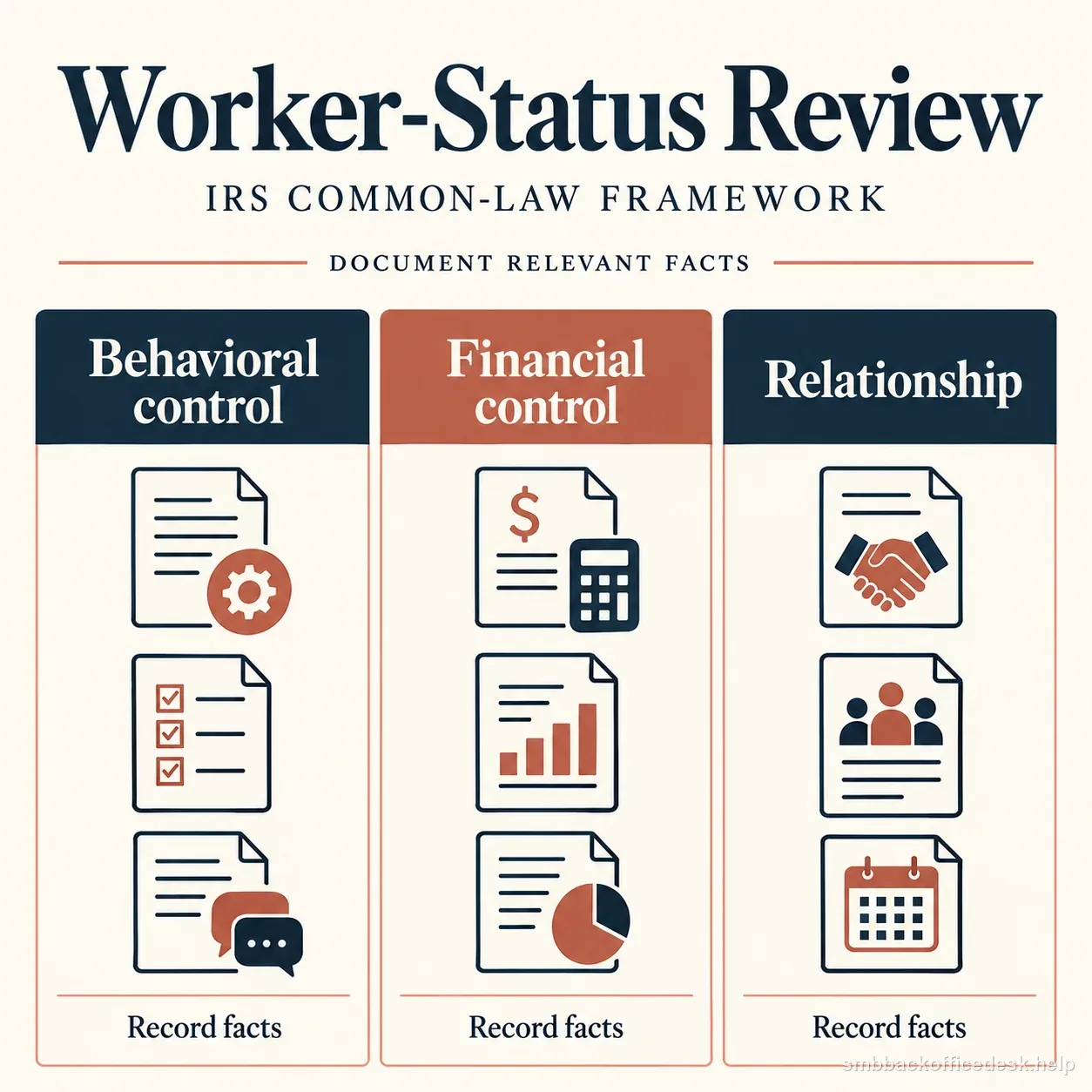
A structured worksheet makes the three fact groups easier to review without turning them into a vote.
Keep other legal tests separate
The IRS categories address federal employment-tax classification, not every labor-law question. The FLSA uses a separate economic-reality analysis. On February 26, 2026, DOL proposed revising that analysis. As of October 31, its rulemaking page still describes the change as a proposal, says the comment period closed April 28, and states that the Department is no longer applying the 2024 rule in its investigations. A proposed regulation and an enforcement policy are separate things; check the current rulemaking page and controlling court decisions for the specific wage-and-hour question. Do not copy the IRS categories into an FLSA review. States can impose their own tests, such as an ABC test, or provide exemptions and alternate standards.
This distinction matters when someone says, “Our accountant says the contractor is fine.” That may address a tax position but not wage-and-hour, unemployment, workers’ compensation, or state-law exposure. Identify the legal question first, then apply the framework that governs it.
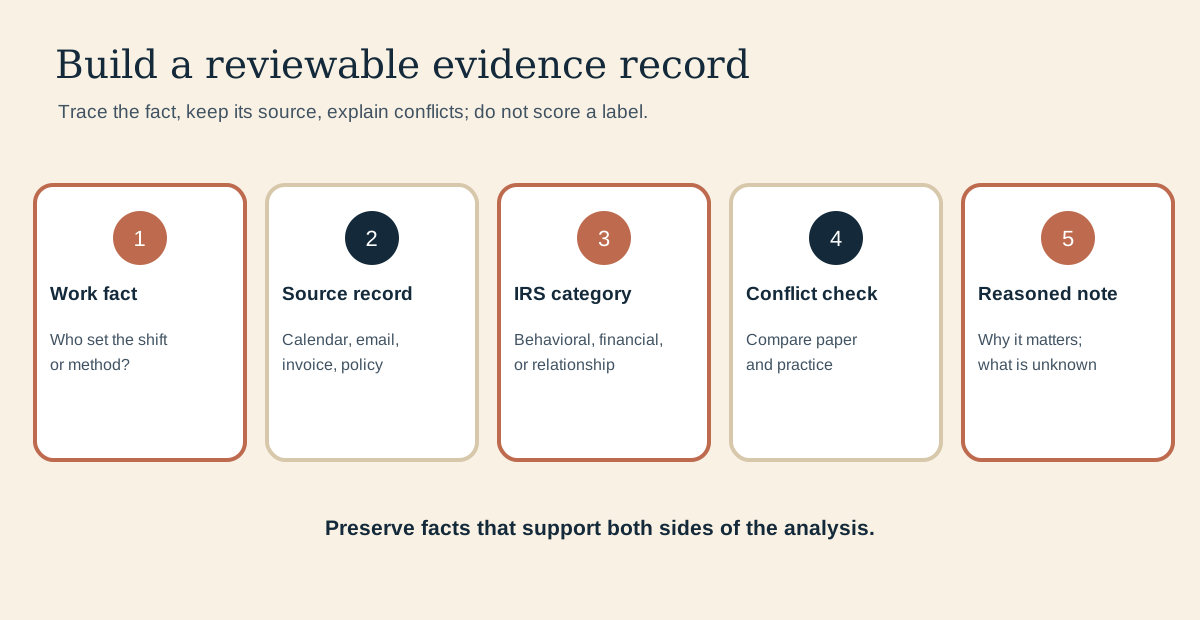
Trace each classification statement from a work fact to its source record, category, conflicting evidence, and written explanation.
A practical review sequence
1. Name the question. Write “federal employment taxes” at the top of this worksheet. If the issue is minimum wage, overtime, unemployment, workers’ compensation, or a state ABC test, open a separate review using that law’s test. A result under one framework should not be copied into another. 2. Describe the job as performed. Record the services, start and end dates, who assigns tasks, who sets hours or location, what the worker may change, and what happens when work needs correction. Avoid labels such as “consultant” unless they are part of the document being reviewed. 3. Collect both sides of the evidence. Include the agreement and invoices, but also schedules, instructions, training, expense records, tool ownership, rework terms, outside-client activity, benefits, and renewal history. Include facts that cut against the company’s preferred conclusion. 4. Tie each statement to a record. Note the record name, date, author, and where it is stored. If practice changed during the engagement, mark when it changed instead of blending different periods together. Keep personal identifiers in restricted files; a general classification worksheet does not need full tax identification numbers. 5. Write a reasoned summary. Explain which facts matter under each category and where facts conflict. Identify what is unknown and how it could be verified. Do not turn the summary into a points tally or present it as a binding IRS decision.
For example, if a contract says the worker chooses the schedule but a manager’s calendar shows recurring assigned shifts, save both records and explain the conflict. Do not silently select the contract clause or calendar entry that supports a desired outcome. Ask the person who set the schedule what happened and retain a dated note. The goal is an accurate record of the relationship, not a document designed to make a predetermined label look convincing.
If the federal tax answer remains uncertain after documenting the real facts, Form SS-8 is the IRS process for requesting a worker-status determination. The IRS says businesses and workers may file, lists situations it will not accept, and warns that a decision can take at least six months. Do not treat it as an instant pre-hire approval. See the Form SS-8 filing overview for that workflow and the small-business 1099-versus-W-2 guide for the wider hiring question.
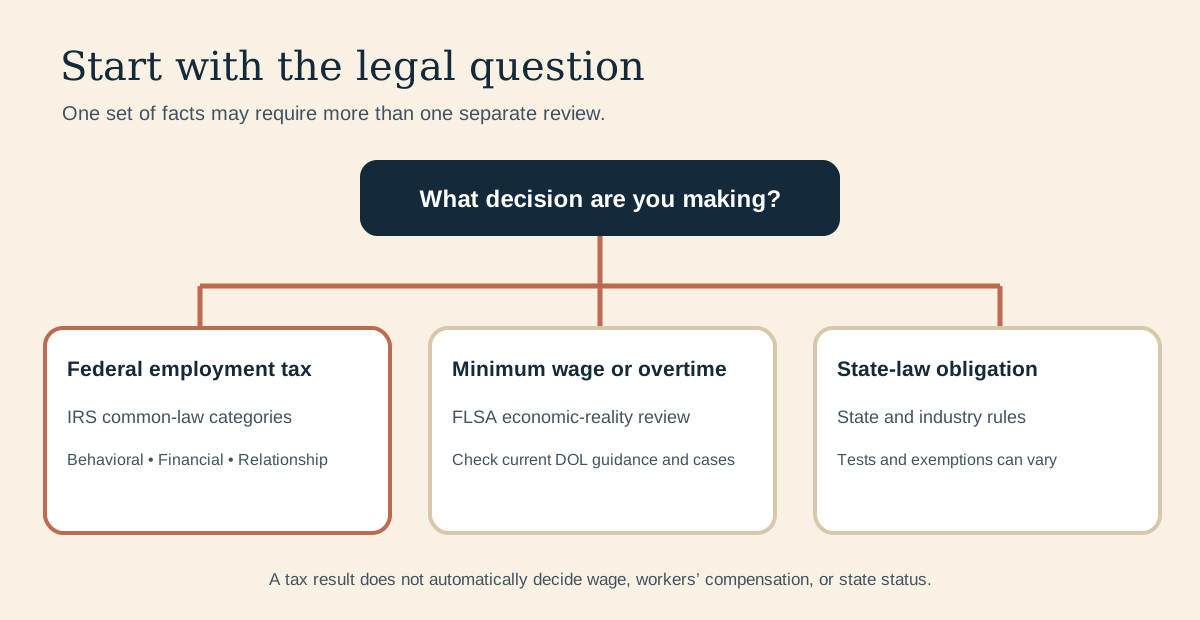
Federal employment-tax, FLSA wage-and-hour, and state-law questions may require separate reviews.