
Workers' compensation is generally an employee benefit, funded and required for employees, not for genuine independent contractors. That single sentence is the part most small businesses remember, and it is also the part that leads to real exposure, because it skips two questions that matter just as much: is the classification actually correct, and does the contractor carry their own coverage for their employees or meet a job-specific insurance requirement.
The baseline rule depends on state law
Workers’ compensation duties usually turn on whether the person is an employee under the law that applies to the work, but the tests, exemptions, and who must secure coverage vary by state and industry. A 1099 form or an IRS tax result does not automatically decide status under a state workers’ comp statute. Some states also impose duties on a contractor that hires a subcontractor’s employees unless coverage is secured. Check the workers’ comp agency and statute for each work location, including any construction or other trade-specific rules, before relying on a general rule.
If classification is disputed after an injury
If a person labeled 1099 is later found to be an employee, the business may owe required benefits, premiums, or penalties for failing to secure coverage. Whether the injured person can also bring a civil claim depends on the state’s statute, who counts as the employer or statutory employer, whether coverage was secured, and the facts. Do not assume the 1099 label removes workers’ comp duties, guarantees tort immunity, or creates an uncapped lawsuit; get prompt state-specific insurance and legal guidance after an injury.
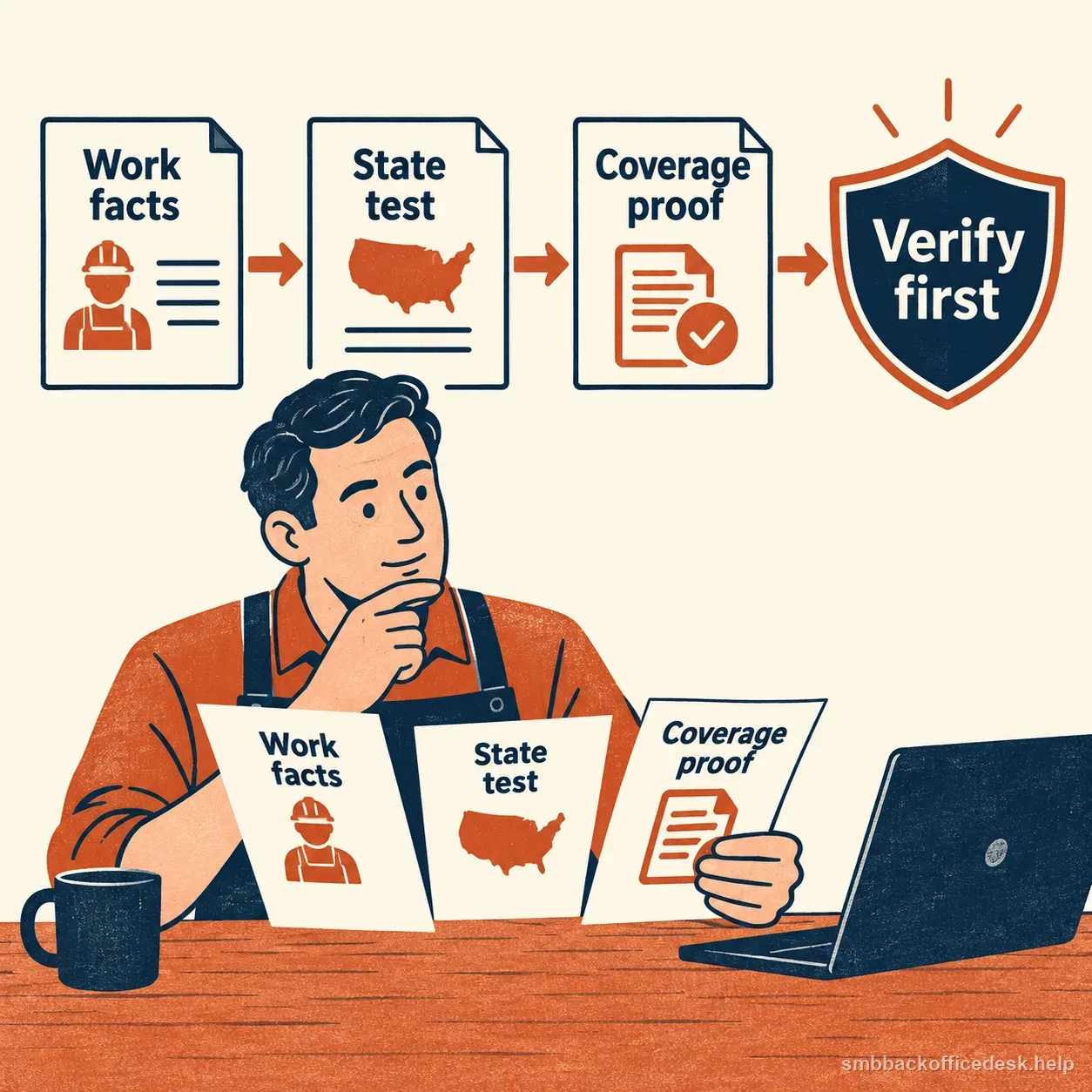
Check classification facts and the state rule before relying on a certificate.
Request and verify evidence of coverage
For contractors who are correctly classified as independent, ask for their own workers’ comp coverage where required by law or contract, and collect current evidence before work begins. A certificate of insurance is evidence of reported coverage, not the policy itself and not a promise that the hiring business is covered. Verify with the contractor’s broker or carrier: confirm the named insured, policy period, workers’ comp coverage, work location/classification where relevant, and that the policy remains active through the job. A certificate is not an additional-insured endorsement; workers’ comp policies generally cover the named employer’s employees. Refresh the evidence when the policy renews or the work changes.
Some industries and states treat this differently by design
Certain industries — construction is the most common example — are frequently singled out for stricter contractor-classification and insurance rules specifically because of historically high injury rates and a documented pattern of misclassification to avoid coverage costs. A state's general worker-classification test for other industries may not be the same test that applies to a construction subcontractor, and some states impose specific licensing or insurance-verification requirements before a general contractor can even legally use a subcontractor on certain jobs. If your business regularly hires contractors in construction, trucking, or another historically high-risk or heavily regulated trade, check whether that state applies an industry-specific workers' comp classification rule rather than relying on the general test.

Check the certificate fields with the broker or carrier; it is not the insurance policy itself.
Sole proprietors without employees are treated inconsistently
Whether a one-person contracting business — a sole proprietor or single-member LLC with no employees — is required to carry its own workers' compensation coverage varies significantly by state and sometimes by industry. Some states exempt sole proprietors with no employees entirely; others require coverage in specific high-risk trades regardless of employee count; still others allow the sole proprietor to file an exemption or waiver. Do not assume a one-person contractor is automatically exempt everywhere, and do not assume a certificate of insurance is unavailable or unnecessary just because the contractor has no employees — some sole proprietors do carry voluntary coverage specifically so they can provide a certificate to hiring businesses that require one.
Contract language helps, but doesn't replace verification
A written agreement stating that the contractor is responsible for their own insurance and that the hiring business is not providing workers' compensation coverage is useful and standard practice, but it is a risk-allocation tool, not a substitute for confirming the actual facts of the working relationship match independent-contractor status, and not a substitute for verifying the contractor's coverage actually exists and is current. A contract clause cannot convert an employee relationship into an independent-contractor relationship if the real facts — the level of control exercised, the permanency of the relationship, and the other factors described in this site's classification guides — point the other way.
What to check before a contractor starts work
Confirm the classification itself is well-supported under both the general tax-classification tests and any state-specific test that applies to workers' compensation in that industry. Request a current certificate of insurance and verify the named insured, policy dates, and coverage type before work begins, not after an incident. Check whether the contractor's state requires or allows an exemption for a no-employee sole proprietor, and get that documentation if relevant. Keep a simple tracking log of certificate expiration dates for any contractor relationship expected to run more than a few months, so a lapsed policy is caught before it matters rather than discovered during a claim.
| Check before work starts | What to confirm | Why it matters |
|---|---|---|
| Classification | The facts support independent-contractor status under the general tax tests and any state workers' comp test for that industry | A 1099 form or an IRS result does not decide status under a state workers' comp statute |
| Evidence of coverage | A current certificate showing the named insured, policy dates, and workers' comp coverage type, verified with the broker or carrier | A certificate is evidence of reported coverage, not the policy, and not coverage for your own business |
| Sole proprietor with no employees | Whether the state requires coverage, allows an exemption, or lets the owner file a waiver | Rules vary by state and sometimes by trade, so do not assume a one-person contractor is exempt everywhere |
| High-risk trades | Whether construction, trucking, or a similar trade has its own classification, licensing, or insurance-verification rule | Some states regulate these trades more tightly than the general test |
| Renewal tracking | A log of certificate expiration dates for relationships that run more than a few months | A lapsed policy is caught before a claim instead of during one |
| Other policies | Whether general-liability or umbrella policies say anything about contractor injuries | They are not workers' comp policies and do not fill a workers' comp gap |
If an injury happens and coverage is unclear
If a contractor is injured while working for your business and it is not clear whether they were properly classified or adequately covered, treat the incident the same way you would treat any potential employee injury: document what happened, preserve records of the working relationship and any insurance certificates on file, and get legal and insurance guidance promptly rather than assuming the 1099 paperwork resolves the question on its own. The classification question in a post-injury dispute is often decided by the actual facts of how the work was performed, not by which tax form was issued at year-end.
Exclusive remedy depends on the governing state law
For employees covered under a state workers’ comp system, benefits are often the exclusive remedy against the employer, subject to statutory exceptions. The rule can differ for a genuine independent contractor, a statutory employer, or a business that failed to secure required coverage. If a 1099 worker is injured, the classification and policy facts may determine both benefit eligibility and potential civil claims. Have counsel and the insurer assess the specific state statute; the exclusive-remedy rule is not a nationwide promise that applies automatically to every contractor relationship.
Illustrative certificate-date check
Suppose a two-week project is scheduled from November 12 through November 26 and the office has certificates for two subcontractors. One certificate lists a policy period through November 30; the other ended November 10. The simple tracker result is one of two documents with dates that appear to cover the planned work, and one follow-up required before assigning that second subcontractor. That arithmetic is only a document-control signal. It does not establish whether either worker is legally an independent contractor, whether the policy actually covers the work being performed, or whether a state exemption applies.
For each record, confirm the named insured, policy period, line of coverage, work description or class where relevant, and active status with the carrier or broker. Then apply the workers' compensation rules for the actual state and industry. If dates, scope, or classification remain unclear, keep the record marked unverified and ask the insurer or state agency what evidence is required. This sample is for organizing a file, not a coverage determination.
| Workers comp | General liability or umbrella | |
|---|---|---|
| Purpose in article | Employee-style workplace injury system | Typically third-party/property exposure |
| Contractor injury gap | May depend on correct classification and coverage | Not a substitute for contractor coverage |
| Check | State rule and current certificate | Policy exclusions and limits |

A business owner reviews work facts and the applicable state rule with a broker while checking the coverage document.
Review other policies separately
General-liability and umbrella policies are not workers’ comp policies. Their treatment of injury claims by a contractor or a worker later found to be an employee depends on the policy wording, exclusions, and other insurance. Ask your broker to review the actual policies and explain who is insured, which injury claims are excluded, and whether employers’ liability or other coverage applies. Do not assume a certificate or umbrella limit fills a workers’ comp gap.